




A New Polygon in the Solar System
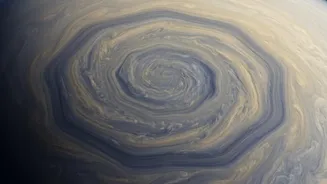
For decades, astronomers have been fascinated by a massive, six-sided jet stream churning around Saturn's north pole. This bizarre hexagon, wider than two Earths, was considered a one-of-a-kind wonder. Now, it has company. Recent observations from the
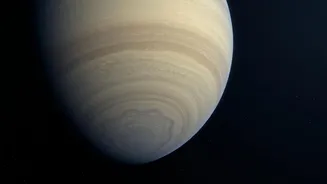
Hubble Space Telescope have revealed a new, distinct polygon forming on the other side of the planet: a ten-sided feature, or decagon, circling the south pole. This newly spotted atmospheric wave is giving scientists a rare opportunity to watch a giant planetary weather pattern develop in real time. Unlike the long-stable hexagon, this southern decagon appears to be a recent development, first hinted at in observations from 2023 and becoming more defined since.
Hexagon vs. Decagon
While both poles now host a polygon, they are not identical twins. The northern hexagon is a remarkably stable feature, observed for over 40 years since it was first seen by the Voyager probes in the 1980s. The southern decagon, however, seems to have formed only in the last few years. Researchers note other key differences: the decagon is located at a slightly less polar latitude than its northern counterpart (around 63°S compared to the hexagon's 78°N). This suggests that while Saturn’s atmosphere has the right conditions for these strange shapes to form, the specific dynamics at each pole are creating uniquely different outcomes. The question is no longer just 'why a hexagon?' but 'why a hexagon in the north and a decagon in the south?'
A Discovery Years in the Making
Spotting the decagon was a collaborative effort that blended professional and amateur astronomy. Because of Saturn's long, slow tilt, its south pole was hidden from Earth's view for over a decade, between 2012 and 2023. As the pole tilted back toward us, astronomers began monitoring it closely. In 2024, amateur astronomers Trevor Barry and Jean-Paul Oger, working with a team led by Agustín Sánchez-Lavega, first noticed a faint, wavy pattern in ground-based images. These early hints prompted a closer look with the Hubble Space Telescope. Hubble's sharp vision confirmed the feature's existence, tracking its development from a subtle wave in 2023 to a more distinct ten-sided pattern by 2025.
What Makes It So Strange?
Planetary atmospheres are governed by fluid dynamics, which typically produce swirls, spirals, and circular vortices, like hurricanes on Earth or Jupiter's Great Red Spot. Straight-edged, geometric shapes like hexagons and decagons are highly unusual because they require a delicate balance of forces to remain stable. Scientists believe these shapes are manifestations of powerful jet streams, where the wind patterns are forced into a repeating geometric wave. However, the exact reason why one pole settled on six sides and the other on ten remains a major puzzle. The discovery also revealed the decagon is not just a surface-level cloud pattern; it extends deep into Saturn's atmosphere, indicating a significant, vertically extended structure.
A Deepening Atmospheric Mystery
The discovery of the decagon has deepened the mystery of Saturn's atmospheric dynamics. For years, scientists wondered why the Cassini spacecraft, which orbited Saturn from 2004 to 2017, never saw a southern polygon. The fact that one has formed now suggests the planet's atmosphere is more changeable than previously thought. Researchers are now working to understand what triggered its formation. One theory suggests a nearby vortex or storm may have perturbed the jet stream, kicking off the wave pattern that settled into ten sides. Future observations with both Hubble and the James Webb Space Telescope will be crucial to see if the decagon becomes a long-lasting fixture like the hexagon or if it is a more transient phenomenon.