




Why Tonight's Sky is Special
The summer solstice, happening around June 21st each year, marks the moment the Earth's North Pole is tilted most directly towards the sun. This gives us the maximum hours of daylight. But what about the night? It means we have the shortest night and
the longest period of twilight. While this shrinks our stargazing window, it creates a unique canvas. The lingering glow on the horizon long after sunset adds a beautiful depth to the sky. Furthermore, the constellations we see now are the classic markers of summer—a celestial changing of the guard that has been observed by cultures for millennia. Tonight isn't just about what you see, but about marking a pivotal moment in Earth's annual journey around the sun.
Your Stargazing Game Plan
To make the most of this short night, a little preparation goes a long way. First, escape the city lights. Even a short drive away from the urban glare will dramatically increase the number of stars you can see. Give your eyes at least 20 minutes to fully adapt to the darkness; this means putting your phone away. If you need a light, use a red torch, as red light is less disruptive to your night vision. You can also use stargazing apps like Stellarium or SkyView to help identify what you're looking at. They use your phone’s GPS and compass to show you a map of the sky in real-time. Finally, get comfortable. A reclining chair or a simple blanket on the ground will save you from a sore neck.
Find the Summer Triangle
The easiest and most rewarding target for any summer stargazer is the Summer Triangle. It's not a constellation but an 'asterism'—a prominent pattern of stars. It’s composed of three bright stars from three different constellations. Look high in the eastern sky after dark for the brightest star you can see; that’s Vega, in the constellation Lyra. To its lower left, you'll find Deneb, the tail of Cygnus the Swan. To the lower right of Vega is Altair, the head of Aquila the Eagle. These three brilliant stars form a large, clear triangle that dominates the summer sky. Finding it is a perfect first step and a gateway to exploring the constellations around it.
Hunt for Planets and the Milky Way
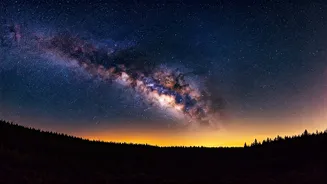
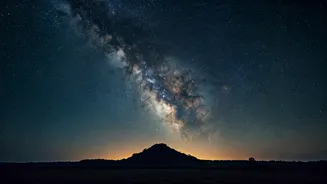
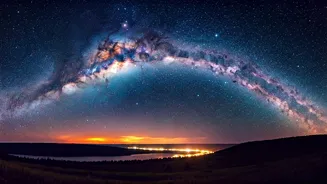
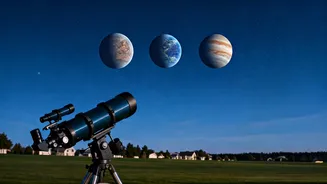
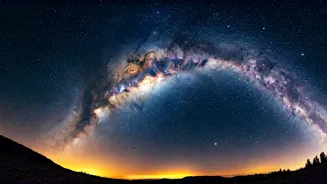
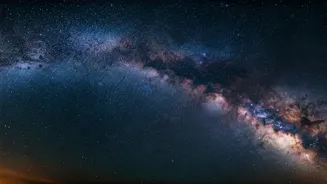
While the sun may be the star of the show during the day, planets and our galaxy take over at night. This time of year, look towards the southeast late in the evening for the planet Saturn, which will rise and travel across the sky through the night. It will appear as a steady, yellowish point of light. The real showstopper, however, is the Milky Way. June is a prime month for viewing the galactic core from India. Once you're in a truly dark location and your eyes have adjusted, look towards the south. You'll see a faint, luminous band of light stretching across the sky, densest around the constellations Sagittarius and Scorpius. It’s a breathtaking sight—you're looking into the heart of our own galaxy.
Explore Ancient Heroes and Clusters
Once you've found the Summer Triangle, you can use it to navigate. Between Vega and the bright star Arcturus in the west lies the constellation Hercules, the Roman hero. It’s a fainter constellation, but it holds a spectacular secret. If you have binoculars or a small telescope, you can hunt for the Great Globular Cluster in Hercules, also known as M13. It’s a tightly packed ball of hundreds of thousands of ancient stars, appearing as a faint, fuzzy patch to the naked eye under dark skies. Seeing it is like looking at a stellar city, a humbling reminder of the scale of the universe. It’s a challenging but deeply rewarding object to find on this special night.