






First, Which 'Day' Are We Talking About?
Before we dive in, we need to clarify what we mean by a 'day'. Here on Earth, the two main types of day are so close in length we barely notice the difference. A 'sidereal day' is the time it takes for the planet to rotate 360 degrees on its axis. For
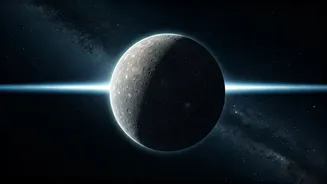
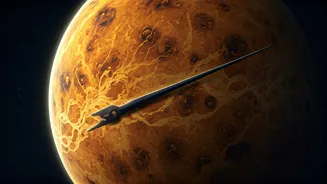
Earth, that's 23 hours and 56 minutes. A 'solar day' is the time it takes for the Sun to return to the same position in the sky, which is our familiar 24 hours. That extra four minutes is the time it takes for Earth to 'catch up' with the Sun after moving along in its orbit. On Mercury, this difference is not minor—it’s colossal. The headline refers to Mercury's sidereal day, its rotation period, which takes about 59 Earth days. That’s roughly two Earth months for the planet to spin just once on its axis. But the story gets even stranger when you look at its solar day.
A Bizarre Cosmic Dance
The secret to Mercury's strange timing is something called spin-orbit resonance. Most moons in our solar system are 'tidally locked' to their planets, meaning they have a 1:1 resonance. Our Moon, for example, rotates exactly once for every one orbit it makes around Earth, which is why we always see the same face.
Astronomers once thought Mercury was tidally locked to the Sun, but it's actually locked in a much more unusual 3:2 resonance. This means that for every two times Mercury orbits the Sun (two Mercurian years), it rotates on its axis exactly three times. Mercury’s year is about 88 Earth days long. So, in the time it takes to complete two trips around the Sun (176 Earth days), it has spun on its axis three times (3 x 59 Earth days ≈ 177 Earth days). This incredibly stable, yet peculiar, rhythm governs everything on the planet.
The Longest Sunrise in the Solar System
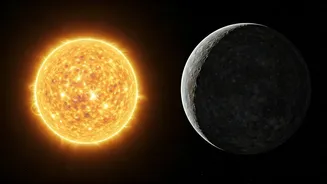
So what does this 3:2 resonance mean for a solar day—the time from one sunrise to the next? It means you’d have to wait an astonishing 176 Earth days for the Sun to return to the same spot in Mercury’s sky. One solar day on Mercury is longer than its own year. In fact, a single solar day spans two full Mercurian years!
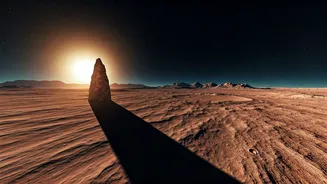
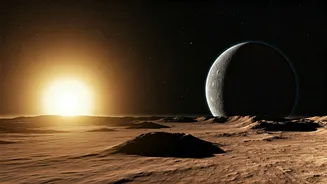
Imagine standing on Mercury. The Sun would rise, but it would appear to move across the sky with agonising slowness. Because Mercury has a very elliptical (oval-shaped) orbit, its speed changes as it travels. When it’s closest to the Sun (a point called perihelion), its orbital speed actually becomes faster than its rotational speed. For an observer on the surface, this would create a truly surreal spectacle: the Sun would appear to stop, move backwards in the sky for a short period, and then resume its slow forward march.
How Did It Get So Weird?
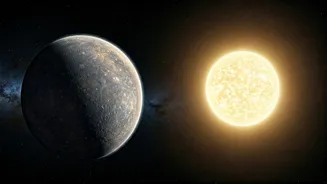
Mercury’s strange rotation is no accident. It’s the result of billions of years of gravitational negotiation with the Sun. The Sun's immense gravity tugs on Mercury, but the planet isn't a perfect sphere. It has a slightly elongated shape and a dense iron core. Over eons, the Sun's tidal forces acted on this asymmetry, slowing Mercury's rotation down from what was likely a much faster spin in its early history.
Instead of locking it into a 1:1 rotation like our Moon, the planet's eccentric orbit allowed it to settle into the next most stable configuration: this unique 3:2 resonance. It’s a gravitational sweet spot, a compromise between the Sun's powerful pull and Mercury’s own momentum, frozen in a delicate cosmic balance.