





The Dual Challenge of Jupiter
Exploring the Jovian system is uniquely difficult for two main reasons: a lack of sunlight and an abundance of radiation. At Jupiter's orbit, more than five times farther from the Sun than Earth, sunlight is only about 4% as intense. This creates a massive
power deficit for any spacecraft relying on solar energy. At the same time, Jupiter's gigantic magnetic field, roughly 20,000 times stronger than Earth's, traps a swirling donut of high-energy particles. This intense radiation can fry sensitive electronics, degrade solar panels, and corrupt scientific data, making long-term operations near moons like Europa incredibly hazardous. Any mission designed to study this potential cradle of life must first overcome these fundamental environmental hostilities.
A Monumental Feat of Engineering
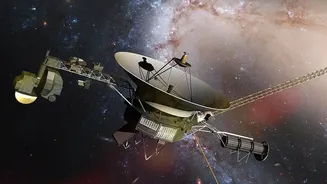
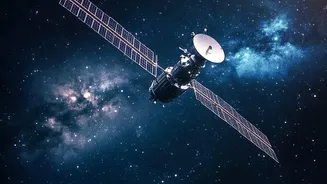
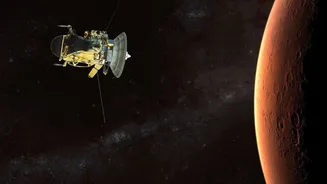
NASA's solution to the power problem is a pair of enormous solar arrays. When fully deployed, the Europa Clipper spacecraft spans over 100 feet (30.5 meters), making it larger than a basketball court and the biggest interplanetary spacecraft NASA has ever built. These massive wings are necessary to capture enough of the faint sunlight to power the mission. Together, the arrays provide a surface area of about 1,100 square feet and will generate at least 700 watts of power throughout the mission—enough to run its computers, heaters, communication systems, and advanced instruments. Designed by Airbus in the Netherlands, the panels are far more efficient than typical solar cells and are built to withstand the extreme cold of deep space, where temperatures can plummet to minus 240 degrees Celsius when the spacecraft is in Jupiter's shadow.
Powering a Suite of Advanced Sensors
The steady power supplied by the solar arrays is the lifeblood for Europa Clipper's nine sophisticated scientific instruments, which are designed to investigate Europa's potential habitability. This suite includes cameras to create high-resolution maps, spectrometers to analyze the chemical composition of the surface, and a thermal imager to spot warmer regions where the ocean may be close to the surface. Perhaps most critically, the arrays power the REASON instrument (Radar for Europa Assessment and Sounding: Ocean to Near-surface). This ice-penetrating radar will scan beneath the moon's frozen crust, searching for the subsurface ocean and any pockets of water that might exist within the ice shell. Another key instrument, the magnetometer, requires stable power to measure Europa's magnetic field, which will help confirm the ocean's existence, depth, and salinity.
An Armored Core for Sensitive Electronics
Generating power is only half the battle; protecting the electronics that use it is the other. To shield its sensitive systems from Jupiter's punishing radiation, Europa Clipper's core electronics—its computers, memory, and instrument processors—are housed inside a specially designed vault. This armored box, with walls made of an aluminum-zinc alloy nearly half an inch thick, dramatically reduces the radiation exposure, a strategy successfully pioneered by the Juno mission. The spacecraft's flight path itself is another layer of protection. Instead of orbiting Europa directly and lingering in the most intense radiation zones, Clipper will make a series of nearly 50 rapid, elliptical flybys, dipping in to gather data before retreating to a safer distance. This clever orbital design maximizes science return while minimizing radiation damage over the course of its multi-year mission.