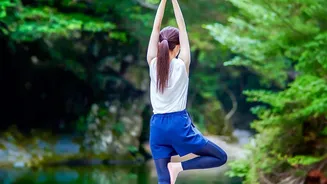







Build from the Ground Up
Your foundation is everything. Before you even lift your foot, stand tall in Mountain Pose (Tadasana) and notice how your weight is distributed on both feet. Shift your weight onto your standing leg and feel all four corners of that foot pressing firmly
into the mat. Imagine roots growing down into the earth. Engage the muscles of your standing leg by lifting the kneecap and firming the thigh. This active engagement creates a strong, stable pillar to support you.
Find a Focal Point (Drishti)
Your eyes guide your body. One of the most critical elements for balance is finding a 'drishti', or a fixed point to gaze at. Choose a spot on the wall or floor in front of you that isn’t moving. Keep your gaze soft but focused. When your eyes wander, your mind and body tend to follow. A steady gaze helps to calm the fluctuations of the mind, which in turn stills the body. This single tip can dramatically improve your ability to hold the pose.
Modify to Build Strength Safely
There is no 'perfect' Tree Pose, only the one that is right for your body today. The most common mistake beginners make is forcing the foot too high, too soon. A crucial safety rule is to never place your foot directly on the knee joint, as this can cause strain. Instead, start with a modification. Place the sole of your lifted foot on your ankle, with your toes resting on the floor like a kickstand. Or, bring the foot to your inner calf. Both options allow you to build strength and stability without the pressure of a 'full' expression. Using a wall or chair for light support is also a fantastic way to build confidence.
Engage Your Core
Balance doesn’t just come from your standing leg; it comes from your centre. Lightly engage your abdominal muscles by drawing your lower belly in and up. This simple action helps to stabilize your entire torso and pelvis, preventing the 'sassy hip' syndrome where the standing hip juts out to the side. When your core is active, you create a line of energy that runs up your spine, making you feel lighter and more controlled.
Embrace the Wobble
Even the most experienced yogis wobble. It’s part of the process. Instead of seeing it as a failure, view each wobble as your body making micro-adjustments and learning to find its centre. Balance is not about being perfectly still; it's about the ability to continually return to your center. If you fall out of the pose, simply take a breath, re-ground yourself, and begin again. Patience is your greatest tool. This mental shift from perfection to practice is key to building true, lasting confidence.
Play with Variations
Once you feel steady, you can begin to explore variations. This keeps the pose interesting and continues to challenge your balance in new ways. Try changing your arm position: bring your hands to prayer at your heart, extend them out to the side like a 'T', or reach them overhead like branches. For a further challenge, you can introduce gentle movement, like swaying your arms in a 'Windy Tree' pose. Every variation offers a new opportunity to learn and grow, turning your practice into a playful exploration.