


Sailing on Beams of Light
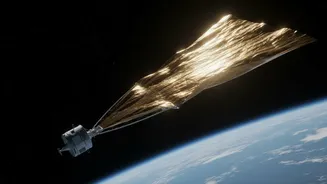
It sounds like science fiction, but the principle behind a solar sail is grounded in fundamental physics. Light, though it has no mass, is made up of particles called photons that carry momentum. When these photons strike a vast, reflective sail in the vacuum
of space, they transfer their momentum, giving the spacecraft a tiny but continuous push. It’s not the solar wind, which is a stream of charged particles, but the pressure of light itself that does the work. While the push from any single photon is minuscule, the constant stream from the Sun adds up. With no friction in space to slow it down, this unending nudge allows a solar sail-powered craft to gradually build up incredible speeds over time.
The Meaning of 'Unlimited' Acceleration
Conventional rockets provide immense thrust for a short period before their fuel runs out. Solar sails are the exact opposite. They offer very low thrust but can maintain it for the entire duration of a mission, as long as they are exposed to sunlight. This is what is meant by "unlimited" acceleration—not that the force is infinite, but that the fuel source is. Unlike a rocket that gets one big push, a solar sail accelerates continuously. This allows it to eventually reach velocities that would be impossible for a chemical rocket of the same mass. However, the strength of the push diminishes as the sail gets farther from the Sun, following an inverse square law. For example, at Jupiter's orbit, the intensity of sunlight is only about 1/24th of what it is near Earth.
Engineering a Craft for Starlight
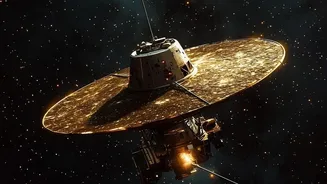
To catch enough photons to generate meaningful thrust, a solar sail must be enormous in area yet incredibly lightweight. Modern sails are made from gossamer-thin materials like Mylar or Polyimide, sometimes only a few microns thick—a fraction of the width of a human hair. These materials are coated with an ultra-reflective layer of aluminum to ensure that as many photons as possible bounce off, maximizing the momentum transfer. The Planetary Society's successful LightSail 2, for instance, used a sail with a combined area of 32 square meters, about the size of a boxing ring, but made of a material just 4.5 microns thick. Future designs call for sails stretching hundreds or even thousands of meters across to propel larger probes on more ambitious missions.
From Ambitious Theory to Proven Tech
The idea of sailing on light has been around for over a century, first proposed by scientists like Konstantin Tsiolkovsky in the 1920s. For decades, it remained a tantalizing concept. The first major breakthrough came in 2010 when Japan's IKAROS mission successfully demonstrated controlled solar sailing on its way to Venus. More recently, The Planetary Society's crowdfunded LightSail 2, which flew from 2019 to 2022, proved that even small, low-cost satellites could use this technology to change their orbit around Earth using only the power of sunlight. These successful demonstrations have paved the way for a new generation of missions, including NASA's plans for the Advanced Composite Solar Sail System (ACS3) and proposals like the Solar Cruiser.
The Future of Interplanetary Journeys
Solar sails are uniquely suited for certain missions that are difficult for traditional rockets. Because their propulsion is continuous, they can be used to "hover" in unstable orbits, such as placing a weather satellite closer to the Sun than is normally possible to provide earlier warnings of solar storms. They are also seen as a key enabling technology for low-cost exploration of asteroids and for reaching the outer solar system. For truly interstellar travel, scientists are exploring the concept of "beam sailing," where a powerful ground-based laser would be aimed at a sail to push it to a significant fraction of the speed of light, something sunlight alone cannot do. While challenges remain, solar sailing is transitioning from a bold idea to a practical and powerful tool for exploring the cosmos.