



A Lifeline of Ice
For centuries, Ladakhi farmers have relied on melting glaciers to water their crops in the crucial spring planting season. But climate change has disrupted this ancient rhythm. Glaciers are receding and the snowmelt often comes too late, leaving fields
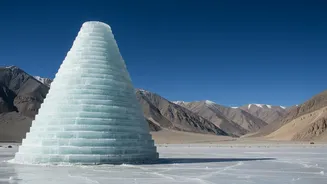
dry when they are needed most. In 2013, innovator Sonam Wangchuk pioneered a groundbreaking solution: the ice stupa. These artificial glaciers, shaped like traditional Buddhist monuments, are created by piping water from streams during winter and spraying it into the frigid air. The water freezes as it falls, forming massive cones of ice that can store millions of litres of water. Unlike earlier horizontal artificial glaciers, the stupa's conical shape minimizes its surface area, allowing the ice to melt slowly and last well into the arid spring months, providing a vital source of irrigation.
A Warming Reality
While revolutionary, the original ice stupa design is now facing the accelerating impacts of the very problem it was designed to solve: global warming. Warmer winters and unpredictable weather patterns are creating new challenges. Unseasonably warm spells can cause the stupas to melt prematurely, while sudden cold snaps can freeze the pipes that feed them, causing system failures. The careful balance required to build and maintain a stupa is being thrown off, threatening the water security for villages that have come to depend on them. The very survival of this ingenious adaptation is at risk, forcing communities to ask a difficult question: how do you adapt an adaptation?
Enter a New Generation
The answer is coming from a cohort of young, locally-trained engineers and innovators, many associated with the Himalayan Institute of Alternatives, Ladakh (HIAL), an institution co-founded by Wangchuk himself. These young people are not just academics; they are residents of the villages that depend on this technology. They bring a combination of modern technical skills and a deep, personal understanding of the region's environmental and cultural landscape. Rather than abandoning the concept, they are embracing the challenge, viewing the ice stupa not as a static invention but as a platform for continuous improvement. Their mission is to make these structures smarter, more efficient, and more resilient to a changing climate.
Engineering for Resilience
The refinements being developed are a blend of clever low-tech and cutting-edge automation. A key focus is on automating the system to reduce the intense labour involved and prevent system failures. One of the biggest problems is water freezing inside the pipes. To solve this, innovators are developing automated systems with sensors that monitor weather conditions in real-time. These smart systems can automatically shut off water flow when temperatures are not optimal for freezing or even expel water from the pipes to prevent them from bursting during extreme cold. This not only protects the infrastructure but also ensures the stupas are built under the most efficient conditions. Other innovations include experimenting with different nozzle designs for better spray distribution and exploring the use of shade nets to protect the ice from direct sunlight, further slowing the melting process.
Early Signs of Success
The results of these new approaches are promising. In 2024, an automated ice reservoir deployed by Leh-based company Acres of Ice in the village of Igoo demonstrated the power of this new technology. The automated system required minimal human intervention and successfully prevented pipe freezing, a common and laborious problem with manual stupas. Farmers in the area reported immediate benefits, with the reliable water supply allowing them to irrigate their fields more frequently during the critical sowing season. Initiatives like 'Hack the Glaciers,' hosted by HIAL, are actively encouraging young engineers and climate enthusiasts to develop these smart automation systems, turning Ladakh into a living laboratory for climate adaptation. These projects prove that with the right blend of local knowledge and technological innovation, the ice stupa can evolve to meet the challenges ahead.