







Destination: A Mysterious Metal World
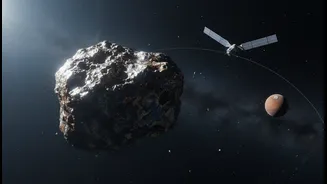
Launched in October 2023, NASA's Psyche spacecraft is on a multi-billion-kilometre journey to a truly unique destination: a metal-rich asteroid also named Psyche. Located in the main asteroid belt between Mars and Jupiter, 16 Psyche is unlike the rocky
or icy bodies we've typically visited. Scientists believe it may be the exposed nickel-iron core of a planetesimal, an early planetary building block that was shattered by ancient collisions. By studying it up close, we could get our first-ever direct look at the kind of metallic core that lies hidden deep within Earth and other rocky planets. The mission's goals are to determine if Psyche is indeed a core, map its surface, and understand the origins of our solar system.
The Art of the Cosmic Slingshot
Getting to the outer asteroid belt is hard. It requires a tremendous amount of energy to push a spacecraft fast enough and into the correct orbit. While Psyche uses highly efficient solar-electric propulsion, firing xenon ions to create gentle but constant thrust, it still needs help. This is where the gravity assist comes in. It’s a technique where a spacecraft flies close to a large body, like a planet, to use its gravity and orbital motion as a shortcut—not for distance, but for energy. Think of a skateboarder grabbing the bumper of a moving bus to get a burst of speed. The spacecraft 'steals' a tiny amount of the planet's immense orbital momentum, flinging it faster and in a new direction without using its own fuel.
A Close Encounter with the Red Planet
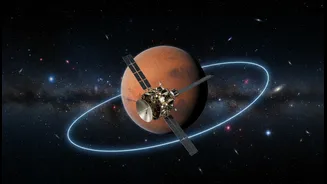
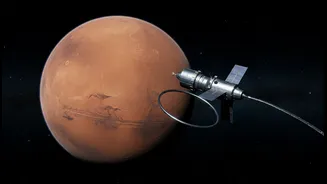
On May 15, 2026, the Psyche spacecraft executed this maneuver perfectly. It screamed past Mars at a relative speed of over 19,000 kph, passing just 4,609 kilometres above the Martian surface. This was close enough for the planet's gravity to grab the spacecraft, bend its trajectory, and give it a significant speed boost. Mission navigators at NASA's Jet Propulsion Laboratory later confirmed the flyby gave the spacecraft a boost of about 1,600 kilometres per hour and tilted its orbital plane by one crucial degree, putting it on a direct path to its final destination. The maneuver saved a huge amount of onboard propellant that would have been needed to achieve the same change in course.
More Than Just a Boost
The Mars flyby wasn't just a propellant-saving pit stop; it was also a valuable dress rehearsal. As the spacecraft approached, passed, and departed Mars, the mission team used the opportunity to calibrate Psyche's science instruments. The multispectral imager captured thousands of observations, including stunning crescent views of Mars and high-resolution images of its south polar ice cap. This allowed engineers to test their imaging and navigation systems, honing the techniques they will need when the spacecraft finally arrives at the much smaller and more mysterious asteroid Psyche. The encounter provided a critical test of the team's ability to navigate and operate the spacecraft in preparation for the main science phase of the mission.
Next Stop: The Asteroid Belt
With Mars now shrinking in its rearview mirror, the Psyche spacecraft is on the final leg of its long cruise. Its solar-electric thrusters are firing once again for the long, 29-month journey deeper into the asteroid belt. If all continues to go as planned, the spacecraft will arrive at the asteroid 16 Psyche in August 2029. Upon arrival, it will spend 26 months in orbit, circling the metal world at various altitudes to map its surface and probe its composition. This will involve creating detailed terrain maps, measuring the asteroid's magnetic field, and analysing its chemical makeup to finally unlock the secrets of this strange and distant world.