




The Quantum Realm of Absolute Zero
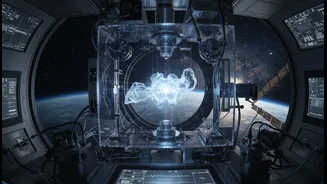
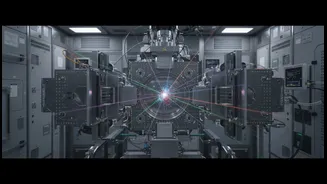
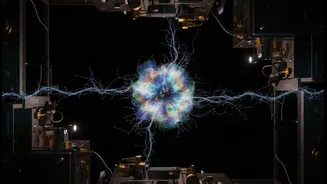
At the heart of this research is a bizarre state of matter called a Bose-Einstein Condensate (BEC). When certain atoms are cooled by lasers and magnets to just a fraction of a degree above absolute zero (minus 273.15 degrees Celsius), they stop behaving
like individual particles and merge into a single quantum wave. In this state, the strange rules of quantum mechanics, usually confined to the microscopic world, become visible on a larger scale. The atoms lose their individual identities and act as one collective entity, allowing scientists to observe their wave-like properties, such as being in multiple places at once, in detail that is otherwise impossible. Creating and studying this fifth state of matter is the key to developing a new generation of ultra-precise sensors.
Why Take a Lab to Space?
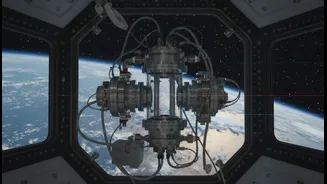
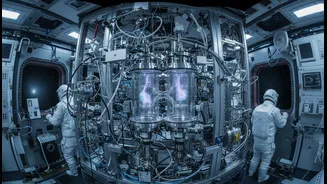
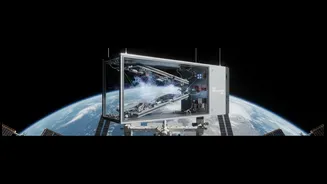
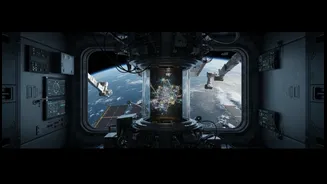
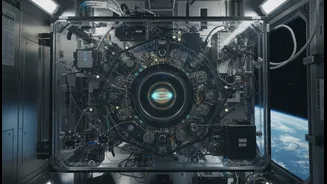
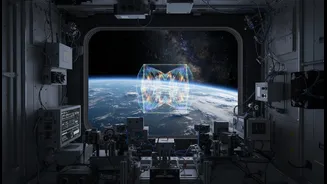
While these experiments can be performed on Earth, gravity is a constant nuisance. The relentless downward pull causes the delicate BECs to dissipate within fractions of a second, limiting how long they can be studied. To get around this, NASA installed the Cold Atom Lab, a facility about the size of a mini-fridge, aboard the International Space Station (ISS). In the microgravity of orbit, atoms are in a state of continuous freefall. This allows scientists, operating the lab remotely from Earth, to observe the ultra-cold atom clouds for much longer periods—sometimes for over a second. This extended observation time is crucial for making the hyper-sensitive measurements needed to test fundamental theories and develop new technologies.
A New North Star for Navigation
One of the most promising applications is in navigation. Future deep-space missions to Mars and beyond will travel far from the reach of GPS satellites. A technology called atom interferometry offers a potential solution. By harnessing the wave-like nature of ultra-cold atoms, these devices can measure acceleration and rotation with extraordinary precision. A spacecraft equipped with a quantum gyroscope could determine its own position and orientation by sensing subtle shifts in its own motion, without relying on any external signals. This would create a self-contained, unjammable navigation system, providing a reliable reference point for journeys into the vastness of space.
Testing the Universe’s Deepest Laws
Beyond practical applications, ultra-cold atoms in space provide a unique laboratory for probing the fundamental nature of reality. Scientists hope to use these experiments to test Einstein's theory of general relativity with unprecedented accuracy. One key tenet, the equivalence principle, states that gravity affects all objects equally, regardless of their mass. By creating a BEC with two different types of atoms (like rubidium and potassium) and observing them in freefall, researchers can check for tiny deviations from this principle that might point toward a new, more complete theory of physics that unites gravity and quantum mechanics. These experiments could also help in the search for mysterious phenomena like dark matter and dark energy.
Sharper Senses for Exploring New Worlds
The same technology that can guide a spaceship can also be used to explore its destination. Atom interferometers are incredibly sensitive to changes in gravity. A future orbiter equipped with a quantum sensor could map the gravitational field of a planet or moon with much greater detail than is possible with current classical sensors. These detailed gravitational maps can reveal secrets hidden beneath the surface, such as the location of water ice, the thickness of an ice shell on a moon like Europa, or the composition of a planet's core. This would allow scientists to study the internal makeup of other worlds without ever having to land on them, revolutionizing planetary science.