

Sailing on a Sea of Sunlight
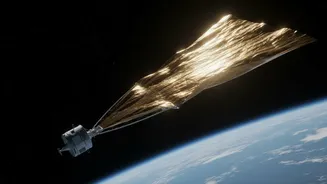
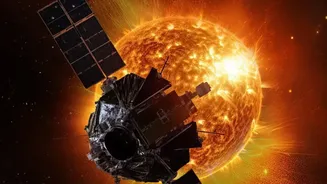
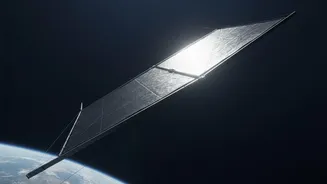
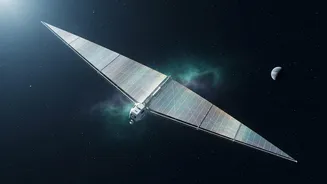
Imagine a giant, ultra-thin mirror, thinner than a human hair, unfurling in the vacuum of space to catch the light of the sun. That, in essence, is a solar sail. Unlike conventional rockets that rely on chemical propellants, solar sails are a revolutionary
form of propulsion. They don't burn fuel; instead, they harness the constant pressure of sunlight itself. It might sound like science fiction, but the principle is grounded in fundamental physics. Light is made up of particles called photons. While photons have no mass, they have momentum. When countless photons from the sun strike the vast, reflective surface of a solar sail, they transfer their momentum, giving the spacecraft a tiny, but continuous, push.
The Ultimate in Fuel Efficiency
The single biggest advantage of a solar sail is that its fuel source is the sun—an essentially limitless and free resource in space. A conventional spacecraft is a slave to its fuel tank; about 95 percent of a space shuttle's launch weight, for instance, was fuel. This limitation, known as the tyranny of the rocket equation, means more fuel is needed to carry more fuel, drastically limiting payload capacity and mission duration. Solar sails sidestep this problem entirely. By eliminating the need for onboard propellant, the weight and volume saved can be dedicated to more scientific instruments, enabling more ambitious missions. This technology is not about getting somewhere fast, but about getting there without the logistical nightmare of carrying your entire fuel supply from Earth.
A Gentle Nudge to Incredible Speeds
The push from sunlight on a solar sail is incredibly gentle, often compared to the weight of a grain of sand on your palm. This means acceleration is very slow. A solar sail won't win a sprint race to Mars against a chemical rocket. But its strength lies in persistence. In the friction-free environment of space, this constant, tiny push adds up. Day after day, the spacecraft steadily accelerates, eventually reaching speeds that would be difficult or impossible for a conventional rocket to achieve on a long journey. This continuous acceleration makes solar sails ideal for long-duration missions, sending probes to the outer planets or even, one day, to other star systems.
Pioneering Missions and Future Plans
Space agencies and private organizations are no longer just theorizing; they are actively flying solar sails. Japan's IKAROS mission, launched in 2010, was the first to successfully demonstrate controlled solar sailing in interplanetary space. More recently, The Planetary Society's LightSail 2 mission proved that a small satellite, a CubeSat, could use sunlight to change its orbit around Earth. Building on this success, NASA is pushing the technology forward. Its Advanced Composite Solar Sail System (ACS3) mission, launched in 2024, is testing new, lightweight carbon fiber booms designed to support much larger sails for future deep-space voyages. Though a recent mission to an asteroid, NEA Scout, failed due to a communications issue, the commitment to the technology remains strong, with a pipeline of missions planned to test even larger and more capable sails.
Challenges on the Horizon
Despite its immense potential, solar sail technology still faces hurdles. The sails themselves must be massive—hundreds of square meters—yet incredibly lightweight and durable, capable of being tightly packed for launch and then reliably unfurled in space. Navigating with such a large, delicate structure is also complex. Furthermore, the thrust from sunlight diminishes the farther a spacecraft travels from the sun, making missions to the outer solar system more challenging. Current technology is also not practical for human missions, as the slow acceleration and payload limitations are significant constraints. However, for robotic science missions, these challenges are seen as engineering problems to be solved, not fundamental barriers.