



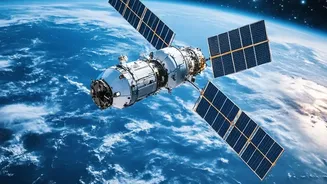
The Constant Drag of Low Orbit
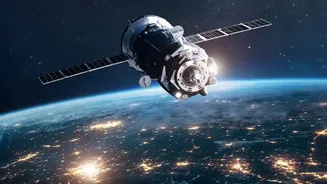
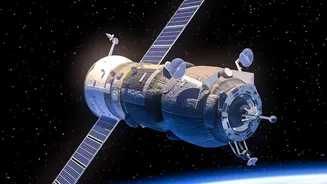
Low-Earth orbit (LEO), an altitude up to about 2,000 kilometers, is a bustling hub for satellites crucial for everything from weather forecasting to global communications. But this region isn't a perfect vacuum. It contains a tenuous atmosphere that,
while incredibly thin, exerts a constant drag force on fast-moving satellites. This friction causes their orbits to decay, slowly pulling them back towards Earth. To counteract this, satellites must periodically fire thrusters to boost their altitude. This requires carrying a finite supply of propellant, like xenon gas for modern electric thrusters. When the propellant runs out, the mission is effectively over, and the satellite eventually de-orbits. This fuel limitation dictates the operational lifespan and limits how low a satellite can practically operate.
A Revolutionary Concept: Breathing Air in Space
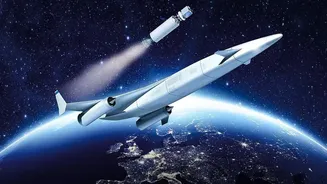
Imagine a jet engine, but for space. That's the core idea behind air-breathing electric propulsion (ABEP), a technology designed to solve the fuel problem. Instead of carrying heavy tanks of propellant, an ABEP system ingests the residual atmospheric particles it encounters in orbit and uses them as fuel. This concept, sometimes called Ram-EP, effectively allows a satellite to 'breathe' its propellant from the environment. By turning the very particles that cause atmospheric drag into a source of thrust, these systems can compensate for the drag force continuously. The European Space Agency (ESA) has been a pioneer in this field, successfully testing a prototype on the ground. The goal is to create a new class of satellites capable of operating for years on end in very low-Earth orbits (VLEO), below 400 kilometers, without needing to carry propellant for station-keeping.
How It Works: From Air to Thrust
The process is elegant in its simplicity, though technologically complex to achieve. First, a specially designed passive intake scoops up the sparse molecules of atmospheric gas—mostly atomic oxygen and nitrogen—as the satellite speeds along at nearly 8 kilometers per second. These collected particles are then channeled into an electric thruster. Inside the thruster, the gas is ionized, meaning it's given an electric charge. An electromagnetic field then accelerates these newly created ions and ejects them at extremely high velocity. This high-speed exhaust generates a small but continuous thrust, pushing the satellite forward and counteracting the atmospheric drag. The entire system is powered by the satellite's solar panels, eliminating the need for any chemical propellants for orbit maintenance.
The Game-Changing Implications
The ability to operate indefinitely without onboard propellant is a paradigm shift for satellite operations. Missions in VLEO, which were previously impractical due to high drag, suddenly become feasible for long durations. Operating at these lower altitudes offers tremendous advantages, including higher-resolution imagery for Earth observation satellites and lower latency for communication constellations. This technology could also lead to smaller and lighter satellites, as the mass and volume dedicated to fuel tanks are eliminated. Furthermore, it has major benefits for space sustainability. When a mission is complete, the propulsion system can simply be turned off, and the satellite will naturally and quickly de-orbit and burn up, reducing the proliferation of space debris.
From Theory to Reality
While the concept has been around for decades, recent advances have brought it closer to deployment. Research teams and companies across the globe, including ESA, the UK Space Agency, and private firms like Phase Four and Orbitt Space in India, are actively developing and testing ABEP systems. Key challenges remain, such as perfecting the design of the air intake to efficiently collect particles and ensuring the long-term durability of thruster components against the corrosive effects of atomic oxygen. However, successful ground tests have proven the principle works. DARPA's Otter program aims to culminate in an on-orbit demonstration, which will be the ultimate test of this transformative technology.