
A Cosmic Shadow Play
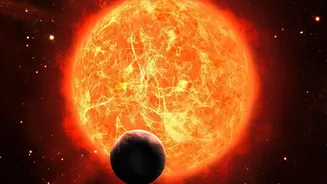
The primary method for studying an exoplanet’s atmosphere is a technique called transmission spectroscopy. It relies on a specific alignment: the planet must pass directly in front of its host star from our point of view, an event known as a 'transit'.
As the planet transits, a tiny fraction of the starlight filters through the very edge of its atmosphere. By capturing this light, telescopes can begin to decipher what that atmosphere is made of. It's like analyzing the light of a distant lighthouse as it shines through the fog; the fog changes the light's properties, telling you something about what it contains.
Decoding the Barcode of Light
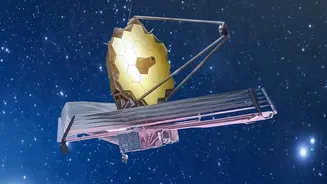
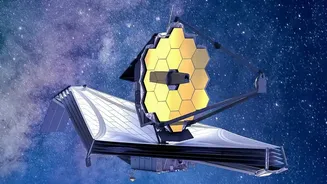
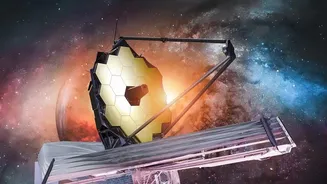
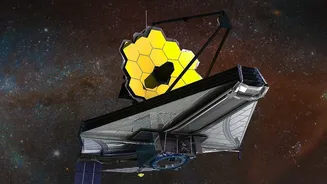
The starlight that passes through an exoplanet's atmosphere doesn't emerge unchanged. Different chemical elements and molecules—like water, methane, or carbon dioxide—absorb very specific wavelengths, or colors, of light. When astronomers analyze the light after a transit, they see a spectrum with dips or missing pieces. These dips act like a unique chemical barcode. If astronomers recognize the signature pattern for water vapor, for example, they know it exists in that alien sky. The powerful infrared capabilities of telescopes like JWST are particularly sensitive to these molecular fingerprints, which are often incredibly faint.
Two Angles of Attack: Transmission and Emission
Transmission spectroscopy is just one tool in the toolkit. Astronomers also use 'emission spectroscopy'. Instead of watching the planet pass in front of its star, they measure the light coming from the planet itself just before it disappears behind the star. This allows them to analyze the planet's own thermal glow. By comparing the combined light of the star and planet to the light of just the star (when the planet is hidden), scientists can isolate the planet's emission spectrum. This technique is crucial for understanding the temperature of an atmosphere and can reveal properties of its cloud tops.
From Light to Weather Maps
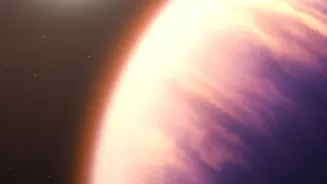
Clouds and hazes have long been a challenge for astronomers because they can obscure the chemical signals from deeper in the atmosphere. However, with advanced techniques, telescopes are now turning this problem into an opportunity. By observing a planet over its full orbit, scientists can create maps of its atmosphere. For example, recent JWST observations of a 'hot Jupiter' named WASP-94A b revealed a daily cloud cycle. The planet's 'morning' side was thick with clouds made of magnesium silicate—a rock-forming mineral—while its 'evening' side was surprisingly clear. This was achieved by measuring the light from the planet's leading and trailing edges as it transited its star.
Building a 3D Picture
By combining observations over time, astronomers are even beginning to create the first 3D maps of exoplanet atmospheres. Using a method called eclipse mapping with JWST, researchers mapped temperature variations on the ultra-hot gas giant WASP-18b. This revealed a scorching hot zone where water molecules might even be getting ripped apart, surrounded by a cooler ring. These pioneering maps help scientists understand atmospheric circulation and how energy is distributed around a planet. While early, this technique is a major step toward understanding alien worlds with the same detail we apply to our neighbours in the solar system.