






The Powerhouse of India's Space Dreams
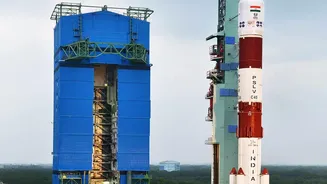
The CE20 cryogenic engine is the indigenously developed workhorse that powers the upper stage of India's heaviest rocket, the Launch Vehicle Mark-3 (LVM3). This is the same rocket trusted for landmark missions like Chandrayaan-3 and, most critically,
the upcoming Gaganyaan human spaceflight program. Cryogenic engines, which use super-cooled liquid propellants like liquid hydrogen and liquid oxygen, are notoriously difficult to build but offer tremendous thrust and efficiency. They provide the powerful final push needed to place heavy satellites into distant orbits or send astronauts safely on their way. The CE20, developed by ISRO's Liquid Propulsion Systems Centre, has been qualified to operate at thrust levels from 19 to 22 tonnes, making it a versatile and vital asset for India's aspirations in space.
Taming the Fire Within
The single most important quality of a rocket engine, especially one carrying humans, is reliability. A key aspect of this is 'combustion stability'. In simple terms, think of it as the difference between a steady, controlled flame and a sputtering, unpredictable one. In a rocket engine, uncontrolled oscillations in pressure, even for a millisecond, can be catastrophic. This phenomenon, known as combustion instability, can create violent vibrations capable of tearing the engine apart or causing destructive heat transfer that melts critical components. These instabilities can be low-frequency, known as 'chugging', which involves the entire propellant feed system, or high-frequency, which are acoustic in nature and the most dangerous. Validating that the CE20's combustion is smooth and stable is therefore not just a routine check; it's a fundamental requirement for mission success and safety.
Simulating Space on Earth
To ensure the CE20 is stable, ISRO engineers conduct a series of grueling ground tests at the ISRO Propulsion Complex (IPRC) in Mahendragiri, Tamil Nadu. These tests aim to simulate the harsh conditions of a real launch, from sea-level atmospheric pressure to the vacuum of space. Sea-level tests are particularly challenging for an engine like the CE20, which is designed for vacuum operation. Its large nozzle can experience 'flow separation' at ground level, leading to dangerous vibrations. To counter this, ISRO has developed innovative solutions like a Nozzle Protection System (NPS). The trials involve a series of 'hot fire' tests, where the engine is ignited for durations ranging from a few seconds to over 10 minutes, as seen in various qualification tests. A recent flight acceptance test on September 9, 2026, successfully demonstrated the engine's performance at an uprated thrust of 22 tonnes.
Reading the Engine's Pulse
During these hot fire tests, the engine is fitted with a battery of sensors that act like a medical check-up, measuring every vital sign. These sensors monitor pressure, temperature, and vibrations at incredibly high frequencies. Engineers are looking for the tell-tale signs of instability: organized, rhythmic pressure spikes instead of random fluctuations. The data is meticulously analyzed to ensure that any pressure oscillations remain well within a safe margin, typically no more than ±5% of the average chamber pressure. ISRO also tests the engine's ignition process under various conditions, using new multi-element igniters, and even validates its ability to restart in flight—a crucial capability for future multi-orbit satellite deployments and complex Gaganyaan mission maneuvers. Each successful test, like those in March and September 2026, confirms that the engine's performance matches predictions and that its combustion remains stable across its entire operating range.
Green Light for Gaganyaan and Beyond
Every successful stability test is a direct step towards making India's human spaceflight mission a reality. The CE20 has been specifically human-rated, meaning it has undergone the most stringent qualification tests to ensure the highest levels of safety and reliability for the Gaganyaan crew. The successful tests at higher thrust levels of 22 tonnes also enhance the LVM3's overall payload capacity, allowing it to carry heavier satellites and enabling more ambitious future projects. This meticulous process of validation—igniting the engine on the ground, pushing it to its limits, and scrutinizing its every pulse—builds the confidence needed to entrust it with our nation's most precious cargo. It is a testament to the engineering rigour that underpins every ISRO success story.