




What is the Dragonfly Mission?
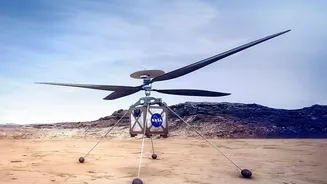
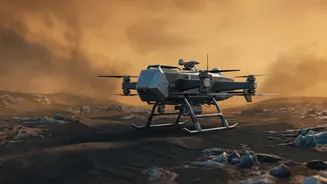
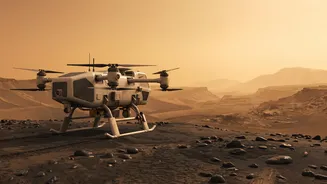
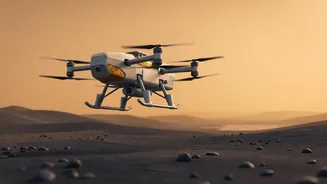
Dragonfly is a revolutionary NASA mission scheduled to launch in July 2028. It involves sending a robotic rotorcraft, essentially a dual-quadcopter drone, to Saturn's moon Titan, with an anticipated arrival in 2034. Unlike stationary landers or slow-moving
rovers that have explored Mars, Dragonfly is designed for mobility. It will be the first vehicle to perform powered, controlled flight on another celestial body, allowing it to travel dozens of kilometres in a single flight. This unique ability will enable scientists to sample and analyse materials from a wide variety of locations, from sand dunes to the floor of an impact crater, covering more ground than all previous Mars rovers combined. The mission's primary goal is to study Titan's prebiotic chemistry and investigate its habitability.
Why Explore Titan?
Titan is one of the most compelling destinations in our solar system. It is the only moon with a dense atmosphere, primarily composed of nitrogen like Earth's, and the only other world besides our own with stable liquid on its surface. However, Titan's rivers, lakes, and seas are filled not with water, but with liquid methane and ethane. Its surface features mountains made of water ice as hard as rock and dunes of complex organic compounds. Scientists believe Titan's environment, rich in carbon-based molecules, may be similar to that of early Earth before life emerged. It offers a unique natural laboratory to study how the building blocks of life form and to investigate the potential for life to exist in environments very different from our own.
How Can a Drone Fly on Titan?
Flying on Titan is, in some ways, easier than on Earth. This is possible thanks to a unique combination of factors. Firstly, Titan's atmosphere is about four times denser than Earth's at the surface. This thick atmosphere provides more lift for the rotorcraft's eight blades. Secondly, Titan's gravity is only about one-seventh of Earth's, meaning the vehicle is much lighter and requires less energy to get airborne. Together, these conditions allow the nuclear-powered Dragonfly, which weighs around 450 kilograms, to fly with relative ease. It will ascend to altitudes of up to 4 kilometres and travel at speeds of around 36 kilometres per hour, hopping between scientifically interesting sites every 16 Earth days, which is one full Titan day.
A Mobile Science Laboratory
Dragonfly isn't just a transport vehicle; it's a fully-equipped mobile laboratory. The majority of its time will be spent on the ground, conducting scientific experiments. To power its operations in the dim light of the outer solar system, it uses a Multi-Mission Radioisotope Thermoelectric Generator (MMRTG), the same type of nuclear power source used by the Curiosity and Perseverance Mars rovers. Its scientific payload includes a suite of advanced instruments. A mass spectrometer (DraMS) will analyse the chemical composition of samples. A drill system (DrACO) will acquire samples from beneath the surface. A gamma-ray and neutron spectrometer (DraGNS) will determine the makeup of the ground under the lander. And a suite of cameras (DragonCam) will provide detailed images of the landscape from both the ground and the air.
The Grand Tour of Titan
The ability to fly from place to place is what makes Dragonfly a game-changer. The mission plans to start in the equatorial dune fields, which are similar to those in Earth's Namib Desert, before making its way toward Selk crater. This crater is a high-priority target because scientists believe the impact that created it could have melted the local water ice, allowing liquid water to mix with the abundant surface organics for an extended period. This creates a potential environment where the chemistry of life could have begun. By visiting geologically diverse sites, Dragonfly will provide an unprecedented understanding of Titan's environment. The mission aims to piece together the story of this fascinating world, from its weather patterns to its subsurface ocean, and perhaps even find clues to the universal origin of life.