








The Heart of the Deal
In a decisive move to bolster its mobile strategy, SpaceX has entered into an agreement to acquire a nationwide portfolio of low-band spectrum licenses. Reports in early October 2026 revealed a deal with investment firm Grain Management for its 800 MHz
spectrum portfolio, reportedly valued at around $8 billion. This follows other significant spectrum investments, including a roughly $17 billion deal to acquire airwaves from EchoStar. These acquisitions are not just about spending money; they are about acquiring the invisible highways that cellular data travels on, a foundational requirement for any company looking to operate a mobile network.
Why Spectrum Is a Game-Changer
Think of mobile spectrum as different lanes on a highway in the sky, each with unique properties. High-band spectrum is like a wide, multi-lane expressway that can carry immense amounts of data at high speeds but covers a short distance. This is great for dense urban areas. Low-band spectrum, like the 800 MHz frequencies SpaceX is acquiring, is more like a country road that stretches for miles and is particularly good at navigating around obstacles. Its key advantage is the ability to penetrate buildings, walls, and foliage, which has historically been a major challenge for satellite-to-phone connectivity. By securing its own licensed low-band spectrum, SpaceX is gaining the crucial ability to provide a reliable signal indoors, a non-negotiable for anyone wanting to compete with established mobile carriers.
Starlink's 'Direct-to-Cell' Vision
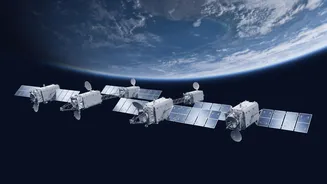
This all serves a singular, audacious goal: Starlink's 'Direct-to-Cell' service. The vision is simple for the user: your standard, unmodified smartphone connects directly to a Starlink satellite when you're outside the reach of a terrestrial tower. Initially, this service, launched in partnership with carriers like T-Mobile, focused on basic text messaging. However, with its own spectrum and a new generation of satellites, SpaceX aims to offer voice, data, and streaming with speeds targeted as high as 150Mbps. The combination of high-capacity mid-band spectrum from deals like the one with EchoStar and the coverage-focused low-band spectrum from Grain Management creates a powerful hybrid model. This layered approach allows Starlink to offer both high speeds and reliable coverage, indoors and out.
The Competitive Landscape
SpaceX isn't operating in a vacuum. The race to connect phones from space is heating up. AST SpaceMobile, which has partnerships with major carriers like AT&T and Verizon, is a direct competitor focused on a similar goal but with a different strategy, using fewer but larger satellites. Companies like Amazon with its Project Kuiper are also building out massive satellite constellations, though their initial focus is on home and business internet rather than direct-to-cell. However, SpaceX's recent moves have sent ripples through the industry, with the stock prices of major US carriers like AT&T, T-Mobile, and Verizon dipping on the news, signaling that investors take the competitive threat seriously. SpaceX President Gwynne Shotwell has openly stated the company expects to win customers from legacy carriers by eliminating dead zones.
Hurdles on the Horizon
Despite the ambitious plans and massive investment, the path forward is not without challenges. The spectrum acquisitions still require final approval from regulatory bodies like the U.S. Federal Communications Commission (FCC), though approvals are widely anticipated. Furthermore, building out the necessary ground infrastructure to create a seamless hybrid network is a monumental task that will take time and significant capital. While the FCC has already greenlit the launch of 15,000 next-generation satellites to power this network, deploying a constellation of that magnitude is a multi-year effort. Some analysts remain skeptical, noting that simply owning spectrum isn't enough to build a competitive network overnight and that partnerships with existing tower operators may be a more likely path than building an entirely new ground network from scratch.