


The Sun’s Hidden Crown
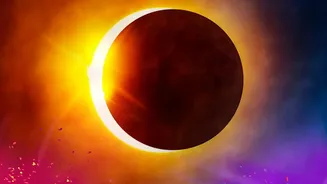
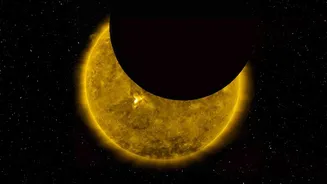
The biggest prize during a total solar eclipse is a glimpse of the solar corona. This is the sun's outer atmosphere, a wispy halo of plasma that stretches millions of kilometres into space. Normally, it’s completely invisible, drowned out by the intense
brightness of the sun's surface, the photosphere. The corona is also paradoxically hotter than the surface, reaching millions of degrees Celsius compared to the photosphere's mere 6,000°C—a mystery known as the coronal heating problem. During the few minutes of totality, when the moon acts as a perfect natural shield, the faint, shimmering corona becomes visible, offering scientists a precious chance to study it directly from Earth.
A Laboratory in the Sky
Scientists treat an eclipse as a unique natural laboratory. They use specialised instruments to dissect the corona's light. Spectrographs, for example, break down the light into its constituent colours, revealing the chemical composition, temperature, and density of the coronal plasma. This technique once led to the discovery of a new element, helium, during an eclipse in 1868. Other instruments called polarimeters measure how light from the corona is polarised, which helps map the sun's incredibly complex magnetic fields. Understanding these fields is key, as they are believed to be the engine that heats the corona and drives space weather, such as solar flares and coronal mass ejections that can affect Earth.
Chasing the Moon's Shadow
To maximise their precious few minutes of observation, scientists go to extraordinary lengths. For the August 2026 eclipse, which will trace a path across Greenland, Iceland, and Spain, research teams will be strategically positioned. Some will use ground-based telescopes, while others will take to the skies. NASA plans to fly its WB-57 high-altitude research aircraft along the eclipse path. Flying at around 50,000 feet, the jet can soar above any potential cloud cover and extend the observation time as it chases the moon's shadow. Student teams will also launch high-altitude balloons in Iceland and Spain to study how Earth's atmosphere reacts to the sudden drop in sunlight, a field of study that helps improve weather forecasting.
Testing Einstein's Universe
It’s not just about the sun. Solar eclipses have been crucial for testing our fundamental understanding of the universe. In 1919, a total solar eclipse provided the first experimental proof of Albert Einstein's theory of general relativity. The theory predicted that a massive object like the sun would bend the fabric of spacetime, causing light from distant stars to curve as it passes by. This subtle shift is normally impossible to see. But during an eclipse, astronomers photographed the stars near the darkened sun and confirmed their positions had shifted exactly as Einstein predicted, cementing a revolution in physics. Some student teams plan to replicate this famous experiment during the 2026 and 2027 eclipses.
Creating Artificial Eclipses
Because natural eclipses are so rare and brief, scientists have developed instruments called coronagraphs to study the corona at any time. A coronagraph uses a small internal disc to block the sun's bright face, creating an artificial eclipse inside a telescope. Spacecraft like the European Space Agency's SOHO and Proba-3 missions use advanced coronagraphs to monitor the sun continuously. However, these artificial eclipses still struggle to reveal the innermost region of the corona with the same clarity as the moon's natural blockade. The unique geometry of a total solar eclipse remains the gold standard, providing an unparalleled view of the region where the solar wind is born and solar storms erupt.