
The Ghost of a Sun
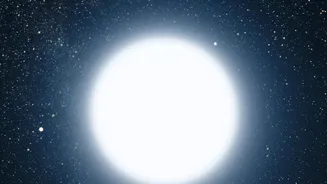
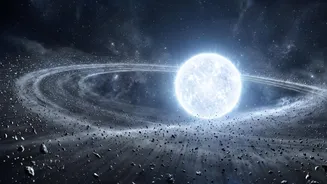
At the heart of this cosmic mystery is a white dwarf, an object with the curious name WD 0816-310, located about 63 light-years from Earth. So, what exactly is a white dwarf? It's the incredibly dense core left behind after a star like our own sun runs
out of fuel. After swelling into a red giant and shedding its outer layers, all that remains is a cooling, Earth-sized ember glowing faintly in space. These stellar ghosts are common endpoints for stars, and studying them gives us a preview of our own solar system's distant future. For a long time, it was assumed that any planets orbiting close to the original star would be utterly destroyed during the violent red giant phase. Any surviving planets would likely be much farther out.
A Planet Born From Ashes
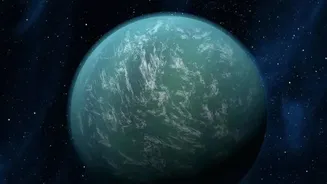
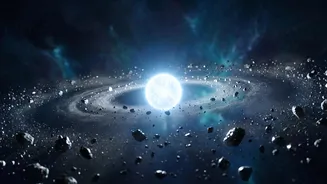
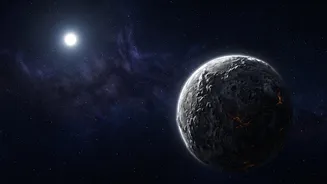
This is where the term 'second-generation' becomes crucial. A 'first-generation' planet would be one that formed with the original star and somehow survived its death throes. But a second-generation planet is something far more exotic. It's a world that forms after the star has died, coalescing from the debris of the old solar system. Imagine the asteroids, moons, and perhaps even planets from the original system being torn apart by the white dwarf's intense gravity. This creates a vast disc of dust and rock orbiting the stellar remnant. The theory is that, over millions of years, this material can clump together to form entirely new planets. This potential discovery around WD 0816-310 is a candidate for exactly this kind of cosmic rebirth.
The Trail of Telltale Clues
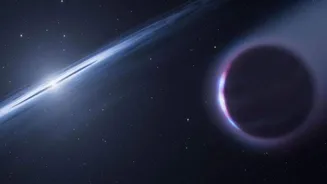
Astronomers haven't actually seen this planet directly. Instead, they've been playing detective. Using the European Southern Observatory’s Very Large Telescope in Chile, a team of researchers observed a disc of planetary debris orbiting the white dwarf. They noticed that the brightness of this debris cloud was dimming in a regular, predictable pattern every 25 minutes. This consistent dip suggests that something large and unseen is gravitationally influencing the debris, pulling it into a specific clump. The most likely culprit is a massive planet, possibly Jupiter-sized, that is 'shepherding' the material as it orbits the white dwarf. This hidden giant is what scientists believe they have indirectly detected. It’s the gravitational footprint, not the object itself, that provides the tantalising evidence.
Rewriting the Rules of Planetary Life
If this discovery is confirmed, its implications are profound. It would be the first time a giant planet has been found orbiting a white dwarf in such a tight embrace. This would provide the strongest evidence to date that planetary systems can indeed be reborn from the wreckage of their parent star's demise. It suggests that the lifecycle of a solar system isn't a simple one-way street from formation to destruction. Instead, it can be a cyclical process where death gives way to new creation. This fundamentally alters our understanding of how and where planets can exist, opening up the possibility that even the graveyards of the cosmos could harbour new worlds. It paints a picture of a universe that is far more resilient and creative than we might have imagined.
The Patient Path to Confirmation
It is vital to remember the second half of the headline: this planet is not yet confirmed. The indirect evidence is strong, but it's not definitive proof. The scientific process demands rigour, and the next step is to seek more direct confirmation. This could involve trying to directly image the planet itself, a monumental challenge given how faint it would be next to the residual glow of the white dwarf. Alternatively, astronomers could look for other subtle signs of its gravitational pull on the star or the surrounding debris. For now, it remains a fascinating and promising candidate. The scientific paper has been published, inviting other astronomers around the world to scrutinise the findings and, if possible, point their own telescopes toward this intriguing system to help solve the puzzle.