







The Legacy of Halley's Comet
The Orionid meteor shower is an annual event that occurs when Earth passes through the trail of cosmic debris left behind by Halley's Comet, arguably the most famous comet in history. While the comet itself only visits the inner solar system every 76
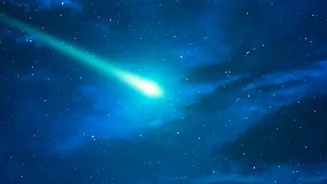
years (its next appearance is in 2061), its dusty trail remains. Each October, our planet intersects this stream of particles. These tiny grains, often no bigger than sand, burn up upon entering our atmosphere at incredible speeds of around 66 kilometres per second, creating the bright streaks we call meteors. The Orionids are known for their speed and brightness, and they occasionally leave behind glowing trails that can linger for a few moments in the night sky.
Peak Dates and Times for India in 2026
Mark your calendars for the night of October 21-22, 2026, which is the predicted peak of the shower. While meteors will be visible for several nights before and after, your best chance of seeing the highest frequency is on this night. However, there's a slight challenge this year: a bright waxing gibbous Moon will be in the sky for much of the night, washing out the fainter meteors. But there's good news. For observers across India, the Moon will set in the early morning hours, creating a dark, moon-free window perfect for viewing. Plan your watch from roughly 3:30 AM IST until the first light of dawn, around 5:15 AM. This pre-dawn period, after the Moon has disappeared, will be your prime time.
Essential Tips for a Successful Watch
To maximise your chances of seeing the Orionids, follow a few simple but crucial steps. First, escape light pollution. The single most important factor is getting away from city and street lights. Second, no special equipment is needed; in fact, telescopes and binoculars are not recommended as they limit your field of view. Your naked eyes are the best tool. Third, be patient. It takes about 20-30 minutes for your eyes to fully adapt to the darkness, so avoid looking at your phone screen. Finally, get comfortable. Bring a blanket or a reclining chair, dress for the chilly pre-dawn weather, and lie back to take in as much of the sky as possible.
A Viewing Guide for Major Indian Cities
Light pollution is the biggest hurdle for urban stargazers. Here’s how to improve your odds in and around major metros: Delhi NCR: The city's immense light dome makes viewing from within the capital nearly impossible. Your best bet is to drive at least an hour out. Areas around Sohna, Damdama Lake, or toward the Sariska Tiger Reserve offer darker skies. Some astronomy groups even host events in places like Greater Noida. Mumbai: As one of India's most light-polluted cities, a trip away from the urban core is essential. Head towards the Sahyadri range. Locations like Bhandardara, Naneghat, Vaitarna, or even the outskirts of Lonavala provide a much darker canvas. Local astronomy groups like Khagol Mandal often organize trips to these sites. Bengaluru: While once a haven for stargazers, Bengaluru's light pollution has grown significantly. Popular spots like Nandi Hills are now too bright for serious viewing. For genuinely dark skies, you'll need to travel further, towards Denkanikottai in Tamil Nadu (about 80 km away), or even further to areas around Coorg. Chennai: Being a coastal city helps, but you still need to get away from the main urban glow. Drive along the East Coast Road, away from resorts and developments, or find a dark spot near Mahabalipuram. For a more dedicated experience, groups like the Chennai Astronomy Club sometimes organize viewing events at dark sites a couple of hours outside the city. Kolkata: The situation is similar to other metros. You'll need to travel towards the rural outskirts. Areas on the fringes of the Sundarbans or any village location far from the highway and city lights will dramatically increase the number of meteors you can spot.
What to Expect and Where to Look
Under perfect, dark-sky conditions, the Orionids can produce about 10 to 20 meteors per hour. From a suburban or light-polluted area, this number will be much lower. It's best to set realistic expectations and enjoy the experience for what it is. The meteors will appear to radiate from the constellation Orion the Hunter, which will be high in the sky during the pre-dawn hours. You can easily find it by looking for the three bright stars that form Orion's belt. However, you don't need to stare directly at the radiant. The meteors can appear anywhere in the sky, and those appearing further from Orion will seem to have longer trails. Simply lie back, look up, and enjoy the show.