



The Grand Cosmic Dance of Mergers
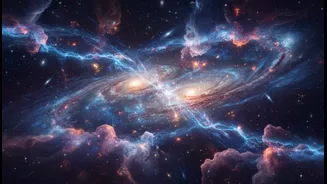
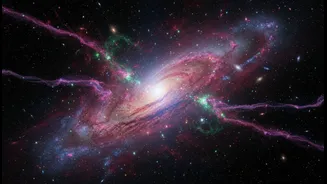
A galaxy collision is one of the most majestic and protracted events in the cosmos. It’s less a violent crash and more a gravitational ballet taking place over hundreds of millions of years. When two galaxies draw near, their mutual gravity begins to
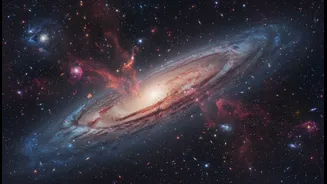
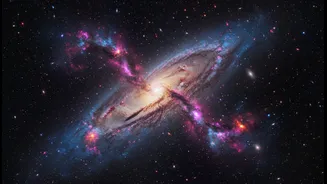
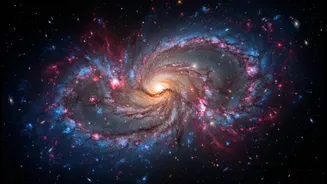
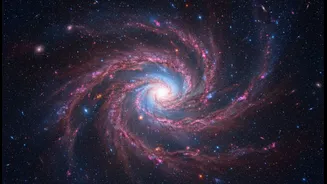
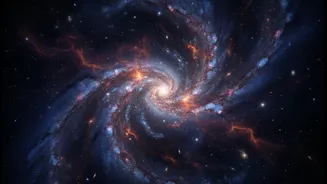
distort their shapes, pulling out long, graceful streamers of stars and gas called tidal tails. A common misconception is that stars within these galaxies smash into each other like cars in a pile-up. In reality, the space between stars is so vast that direct stellar collisions are exceptionally rare. Instead, the galaxies pass through one another, their stars' orbits are scrambled, and they eventually merge to form a new, often larger and more elliptically shaped galaxy. This process can trigger intense bursts of star formation as clouds of interstellar gas and dust are compressed, igniting countless new suns. Images from telescopes like the Hubble and James Webb Space Telescope show these beautiful, chaotic structures in stunning detail, revealing the slow-motion process of galactic evolution in action.
The Ferocious Engine of a Black Hole
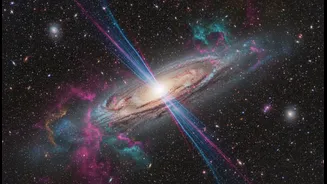
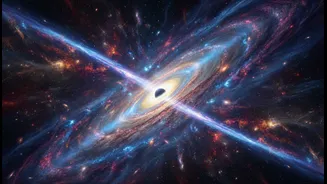
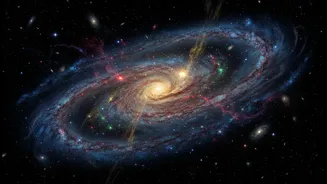
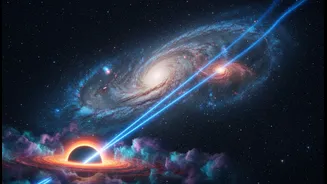
Black-hole activity, on the other hand, is a much more localized and ferociously energetic phenomenon. This term usually refers to an Active Galactic Nucleus, or AGN. At the heart of most large galaxies, including our own Milky Way, lies a supermassive black hole millions or even billions of times the mass of our sun. Most of the time, these giants are quiet. But when gas, dust, or an unfortunate star strays too close, it gets pulled into a swirling, superheated structure called an accretion disk. This material accelerates to near-light speeds, and the intense friction and magnetic fields cause it to glow brighter than all the stars in the host galaxy combined, creating a quasar. Instead of just sucking everything in, this process is incredibly messy. Powerful jets of particles are often launched from the black hole's poles, shooting far out into space at relativistic speeds. So, when we talk about 'black-hole activity', we're talking about the light and energy blasting from the material around the black hole, not the black hole itself.
Where the Lines Get Blurry
The primary reason for confusion is that these two distinct events are often linked. A galaxy collision is one of the most effective ways to feed a dormant supermassive black hole. As two galaxies merge, the gravitational chaos can disrupt the stable orbits of gas and dust, funneling huge quantities of material toward the galactic center. This provides a fresh supply of fuel for the supermassive black hole, switching it on and triggering a powerful AGN phase. In fact, studies show that the most luminous AGNs are almost always found in merging galaxies. A perfect example is the galaxy Centaurus A, which shows both the structural scars of a past merger and powerful jets being launched by its active central black hole. So, you can have a galaxy collision that causes black-hole activity, but the collision itself is the large-scale gravitational interaction of two galaxies, while the activity is the result of matter accreting onto the central black hole.
What the Visuals Tell Us
For the visual-science fan, knowing what to look for helps separate the phenomena. Galaxy mergers are defined by large-scale, distorted structures. Look for the tell-tale tidal tails, warped disks, and widespread bursts of star formation across tens of thousands of light-years. The light is from billions of individual stars and glowing gas clouds. Black-hole activity, by contrast, is about the nucleus. The defining features are an incredibly bright, point-like core that can outshine the entire galaxy, and, in some cases, narrow, highly-collimated jets of plasma shooting out from the center. While a merger reshapes an entire galaxy, an AGN is an energetic outburst from a tiny central region. Telescopes observe them differently, too. The James Webb Space Telescope's infrared capabilities can peer through the dust of a chaotic merger to see both the new star formation and the obscured, active black hole at its core, helping astronomers piece together how these events influence each other.