




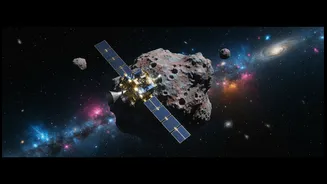


A Famous Explorer's Second Act
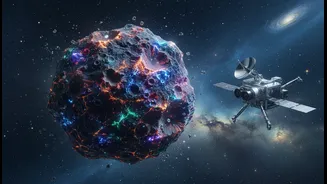
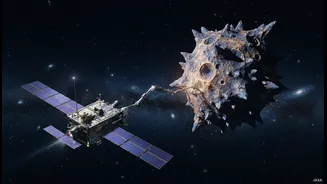
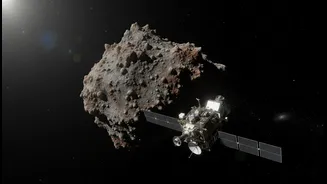
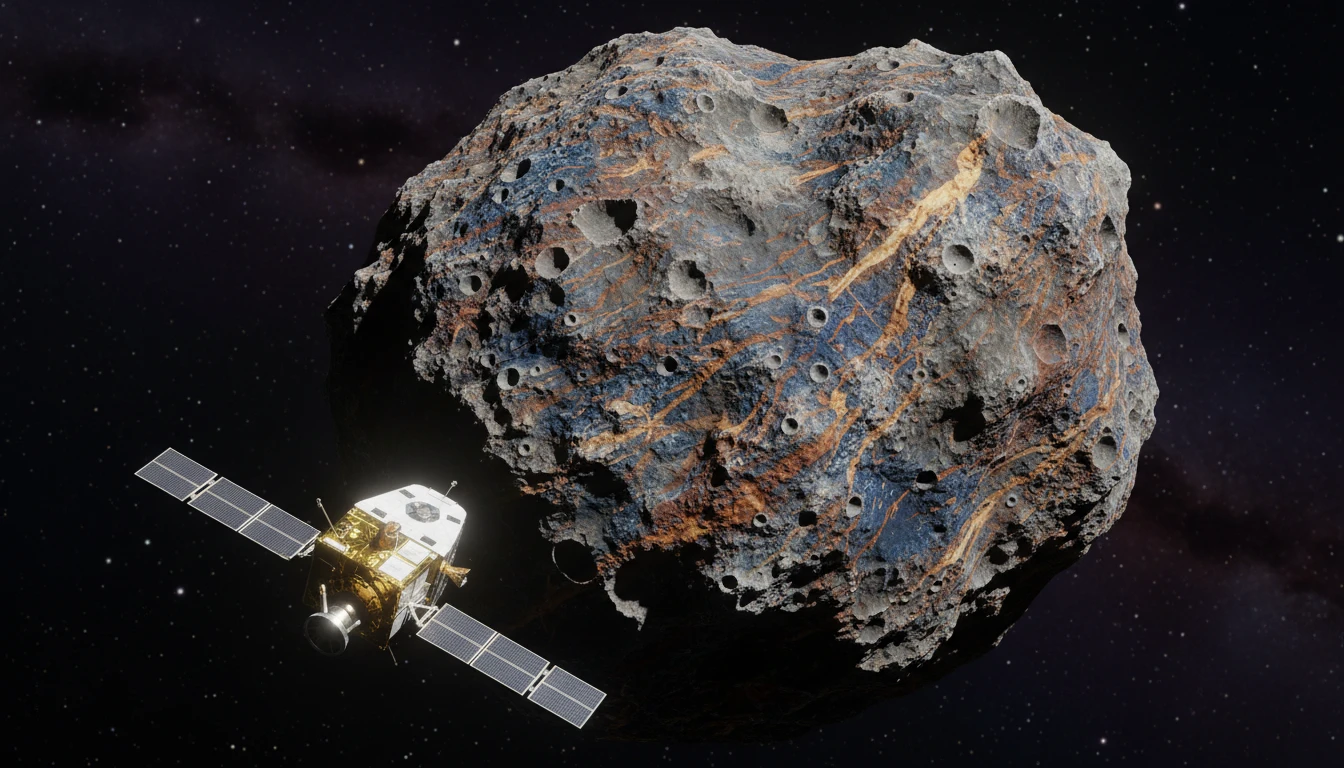
First, let's meet the hero of our story: Hayabusa2. This is the same Japan Aerospace Exploration Agency (JAXA) probe that made headlines in 2020. It achieved an incredible feat by landing on an asteroid named Ryugu, collecting dust and pebbles, and returning
them to Earth in a capsule. Those samples gave scientists a pristine look at the building blocks of our solar system. Instead of retiring, the healthy spacecraft was sent on an extended mission to visit more cosmic neighbours, with its fuel-saving ion engines pushing it deeper into space.
Target: The 'Snowman' Asteroid
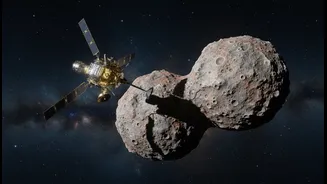
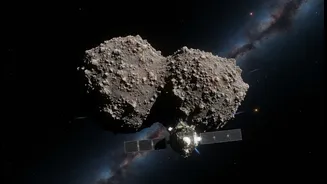
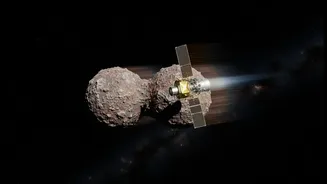
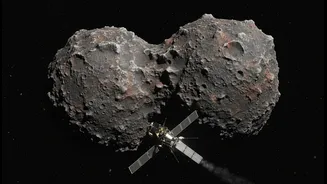
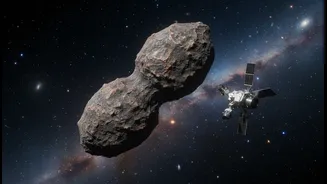
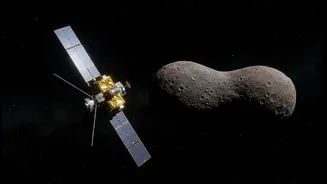
The first target on this new journey was 98943 Torifune (also known as 2001 CC21). On July 5, 2026, Hayabusa2 sped past this space rock at a blistering speed of about 5 kilometres per second. Early images from the flyby revealed something fascinating: Torifune is what scientists call a 'contact binary', looking like two asteroids stuck together to form a snowman shape. It’s about 450 metres wide and is a stony, or S-type, asteroid. This encounter was especially challenging because the probe had to be navigated precisely at high speed toward a small, dark object that only became visible a few days before the approach.
Why This High-Speed Flyby Matters
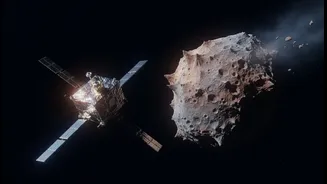
This wasn't a sample collection mission like the one at Ryugu. The main goal of the Torifune flyby was to test technology and gather data crucial for planetary defence. By successfully navigating a high-speed close encounter, JAXA has demonstrated a key capability: how to accurately guide a probe towards a small celestial body. This is vital for future missions that might need to intercept an asteroid, perhaps to nudge it away if it posed a threat to Earth. Think of it as a high-stakes dress rehearsal for protecting our planet. Studying asteroids of Torifune's size is important, as an impact from a similar object could cause significant damage.
Science, a Shared Human Goal
Every space mission, regardless of the flag on the rocket, adds to a collective pool of human knowledge. The data from Hayabusa2's various instruments—its cameras, spectrometer, and thermal imager—will help scientists understand the composition and structure of S-type asteroids. This information helps us piece together the history of our solar system and understand the variety of objects that populate it. It complements what we learned from the C-type asteroid Ryugu and what NASA is learning from its OSIRIS-REx mission, which also returned asteroid samples. International collaboration is common, with data and even physical samples being shared among space agencies.
What This Means for India's Ambitions
For a nation with a burgeoning space program like India, missions like Hayabusa2 are a source of both inspiration and valuable information. As the Indian Space Research Organisation (ISRO) pushes forward with ambitious projects like Gaganyaan (human spaceflight) and future planetary explorations, the technological hurdles overcome by JAXA offer important lessons. The techniques used for autonomous navigation, deep-space communication, and high-precision manoeuvres are relevant to all space-faring nations. Furthermore, the scientific findings on asteroid composition are crucial for planning future Indian missions, whether for scientific study or the long-term prospect of resource utilisation in space. It reinforces the idea that space is a collaborative frontier where every success provides a stepping stone for the next explorer.