



A Renewed Focus on a Hellish World
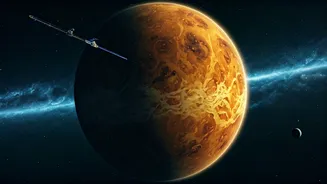
For decades, Mars has captured our imagination, but the spotlight is now shifting to Earth's other neighbour. A flurry of missions from multiple space agencies are planned for the coming decade, all aimed at our so-called 'sister planet'. NASA is preparing
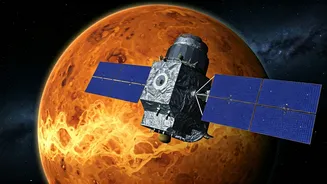
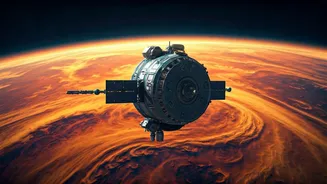
two missions, VERITAS and DAVINCI, scheduled for the late 2020s or early 2030s. The European Space Agency (ESA) is also in the game with its EnVision orbiter, planned for a 2031 launch. And crucially, the Indian Space Research Organisation (ISRO) is deep in the planning stages for its own Venus Orbiter Mission, Shukrayaan-1. While the exact launch date has shifted, with 2028 or 2031 being possibilities, India's entry marks a significant moment, positioning ISRO alongside global leaders in planetary exploration. This convergence of missions from different nations has created a competitive yet collaborative push to unlock the secrets of this mysterious world.
Venus: Earth's Cautionary Tale
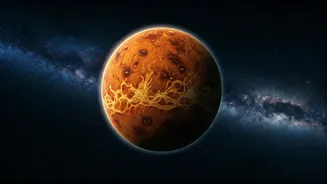
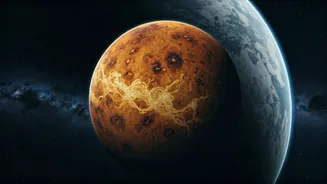
Why the sudden excitement about a planet with surface temperatures hot enough to melt lead and a crushing atmosphere 90 times denser than Earth's? The answer lies in its stark differences and haunting similarities to our own world. Venus is nearly identical to Earth in size and composition, and scientists believe it may have once hosted liquid water oceans for as long as two billion years. However, at some point, its climate took a devastating turn. A runaway greenhouse effect, driven by a thick atmosphere composed almost entirely of carbon dioxide, trapped enormous amounts of heat, boiling off its oceans and creating the hellish landscape we see today. This makes Venus a perfect natural laboratory for studying what happens when a planet's climate system goes catastrophically wrong. For climate scientists, it’s not just an alien world; it’s a grim postcard from a potential future, offering invaluable lessons on the fragility of planetary habitability.
India's Stake: The Shukrayaan Mission
Following the monumental successes of Chandrayaan to the Moon and Mangalyaan to Mars, ISRO's Shukrayaan-1 is India's next ambitious leap in interplanetary exploration. The mission, which received government approval in late 2024, plans to send an orbiter equipped with around 100 kg of scientific instruments to study Venus for several years. The key objectives include mapping the planet's surface and subsurface using a high-resolution synthetic aperture radar, studying its complex atmospheric chemistry, and investigating volcanic activity. Indian researchers, including teams from institutions like Banaras Hindu University, are already involved in global efforts to geologically map Venus, ensuring India's scientific community is at the forefront when these new missions begin sending back data. Shukrayaan represents not just a technological challenge but a major opportunity for India to become a powerhouse in planetary science.
From Venusian Clouds to Indian Monsoons
The excitement among Indian climate experts stems from a direct and critical need. The data gathered from Venus, particularly about its extreme atmospheric dynamics and runaway greenhouse effect, is vital for refining our own climate models. Better models mean better predictions for climate-sensitive phenomena that directly impact life in India, such as the intensity and reliability of monsoons, the frequency of extreme heatwaves, and the rate of sea-level rise. By understanding the atmospheric physics on a planet that represents an extreme climate outcome, scientists can stress-test and improve the computer models used to forecast Earth's future climate. As JAXA, Japan's space agency, notes, creating a 'universal planetary meteorology' by studying other atmospheres helps us understand our own much more deeply. The insights gained from the thick, acidic clouds of Venus could one day help India better prepare for the climate challenges on Earth.