



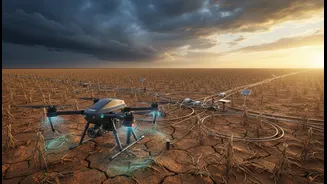



From a Gamble to a Game Plan
The success of India's agricultural sector, which supports millions of livelihoods, has always been tied to the unpredictable whims of the southwest monsoon. This annual rainfall accounts for about 70% of the country's total precipitation and is crucial
for the Kharif crop season. Traditionally, farmers have had to make critical decisions—what to plant, how much land to cultivate, and when to sow—based on experience, intuition, and short-term weather updates. This created a high-stakes environment where a delayed or weak monsoon could lead to significant financial losses, while an unexpectedly good one could mean missed opportunities for those who planted conservatively. This cycle often trapped farmers in a low-risk, low-return pattern, discouraging investment in higher-value crops or modern inputs.
The AI-Powered Revolution in Forecasting
The game is changing thanks to significant leaps in weather prediction technology. The India Meteorological Department (IMD), in collaboration with various national and international research institutes, has been enhancing its capabilities. The introduction of AI-enabled systems, dynamical models, and supercomputing power has moved forecasting beyond short-term predictions. These new models can now provide extended-range forecasts, offering insights into monsoon onset, rainfall distribution, and potential dry spells up to four weeks in advance. This is a massive improvement over traditional five-day forecasts. By blending AI models with vast historical weather data, forecasters can now generate more accurate and hyperlocal predictions, sometimes down to the block or sub-district level.
Smarter Decisions on the Ground
So, what does a four-week lead time actually mean for a farmer? It means everything. Armed with a reliable long-range forecast, a farmer can make strategic, data-driven decisions. Studies have shown that when farmers receive accurate forecasts, they adjust their plans accordingly. If the forecast predicts an early and robust monsoon, a farmer might choose to plant a higher-value cash crop like cotton, which requires a longer growing season. They might also invest more in cultivating a larger area of land. Conversely, if the forecast suggests a delayed or weak monsoon, a farmer can opt for drought-resistant, lower-value subsistence crops, reduce the amount of land they plant, and cut back on expensive inputs like fertilizer to minimize potential losses. This allows for optimized use of resources like water and pesticides, preventing waste from unexpected rainfall patterns.
Beyond the Farm Gate
The impact of better forecasting extends far beyond individual farms. It creates a ripple effect across the entire rural economy and national food security apparatus. When farmers can plan more effectively, crop yields become more stable and predictable. This helps in managing supply chains, controlling food price inflation, and informing government policies related to procurement and storage. Furthermore, it empowers farmers to manage risk proactively. For instance, a forecast for a poor monsoon might prompt a farmer to seek alternative off-farm employment for the season, diversifying their income and building economic resilience. This shift from reactive crisis management to proactive planning is crucial for adapting to the increasing weather variability caused by climate change.
The Path to a Climate-Resilient Future
The rollout of these advanced forecasting systems is already reaching millions of farmers through SMS, WhatsApp, and other digital platforms. In 2025, one initiative successfully delivered AI-powered forecasts to 38 million farmers across India. However, challenges remain. Ensuring this vital information reaches the last mile—every farmer, regardless of their access to technology—is a critical next step. Continued investment in observational infrastructure, like Doppler radars and automatic weather stations, is also needed to further refine the accuracy of these hyperlocal models. While the science has made incredible strides, its true success will be measured by its ability to consistently empower every Indian farmer to look at the sky not with uncertainty, but with a confident strategy in hand.