




A Flawless Flight into the Future
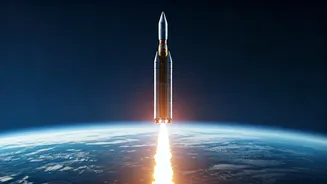
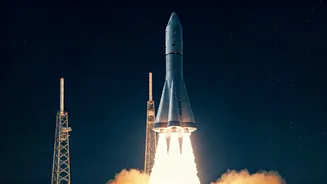
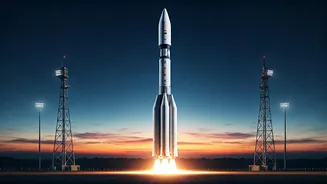
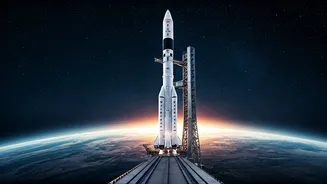
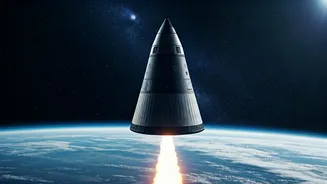
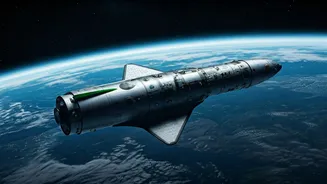
In a display of precision and reliability, ISRO has successfully conducted the first uncrewed flight test of its Gaganyaan spacecraft, designated G1. Launched from the Satish Dhawan Space Centre in Sriharikota, the mission saw the powerful, human-rated
LVM3 rocket place the orbital module into a precise low-Earth orbit. [2] The module, comprising the crew capsule and service module, performed a series of manoeuvres before the crew capsule separated and executed a perfect re-entry, splashing down safely in the Indian Ocean. This test was designed to validate all the critical systems required for human spaceflight, including the launch vehicle, the crew module's life support and control systems, and the crucial re-entry and recovery operations. [12] The success of this uncrewed mission is a monumental step, proving the systems' robustness before astronauts, or 'Vyomanauts', climb aboard.
The Significance of Gaganyaan
The Gaganyaan programme is not just another mission; it's a national endeavour to demonstrate the capability of sending a crew of three astronauts to an orbit of 400 km and bringing them safely back to Earth. [12, 14] Successfully completing this will make India only the fourth country in the world—after the United States, Russia, and China—to have an independent human spaceflight capability. [3] This milestone is about more than just national prestige. It's a catalyst for technological advancement and economic growth. The mission is expected to create around 15,000 new employment opportunities and will source nearly 60% of its components from the Indian private sector, giving a significant boost to domestic industries. [3, 14] Furthermore, it will inspire a new generation of scientists and engineers, reinforcing India's position as a major player in the global space arena. [3]
Building on a Legacy of Frugal Innovation
This latest success is built on the shoulders of ISRO's past triumphs, which have been defined by a unique combination of ambition and cost-effectiveness. From launching its first satellite, Aryabhata, in 1975 to becoming the first nation to reach Mars orbit on its maiden attempt with the Mangalyaan mission in 2013, ISRO has consistently pushed boundaries. [5] More recently, the historic landing of Chandrayaan-3 near the lunar south pole in 2023 cemented India's reputation for pioneering complex missions. [7, 10] The Gaganyaan programme continues this legacy. It leverages proven technologies like the LVM3 launch vehicle while developing new, critical systems like the Crew Escape System to ensure astronaut safety, which is paramount in any human spaceflight mission. [2, 12]
The Road Ahead: A Space Station and Beyond
The successful G1 flight is a critical checkpoint, but the journey is far from over. ISRO has planned subsequent uncrewed missions to further test and refine every system, including one that will carry 'Vyommitra,' a sophisticated humanoid robot, to simulate human functions and gather vital data. [6] These preparatory steps are essential for the ultimate goal: the first crewed Gaganyaan flight. Beyond Gaganyaan, India has even grander ambitions. The programme is a stepping stone towards establishing a 'Bharatiya Antariksha Station' (Indian Space Station) by 2035, enabling long-duration human presence in space. [7, 9] These efforts are part of a long-term vision that includes crewed lunar landings and further interplanetary exploration, securing India's future as a leading spacefaring nation. [15]