





The Sun’s Invisible Threat
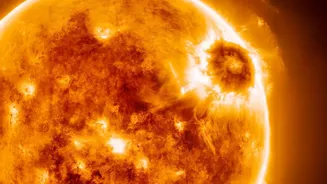
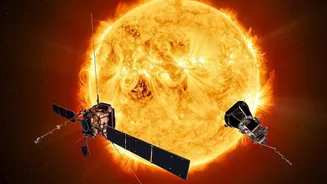
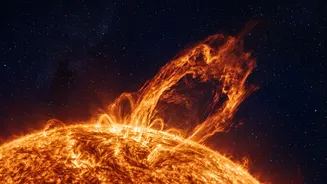
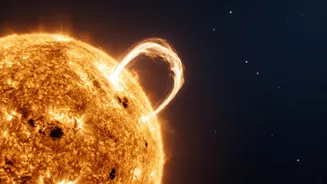
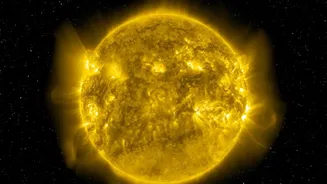
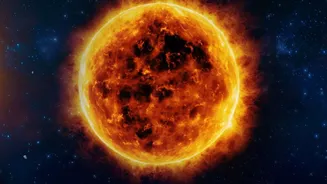
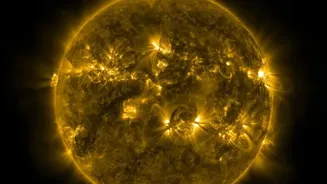
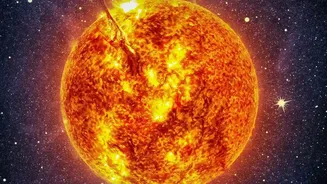
We often think of the Sun as a steady source of light and warmth, but it's a dynamic and sometimes violent star. It constantly ejects a stream of charged particles called the solar wind. Occasionally, it releases massive bursts of energy and plasma, known
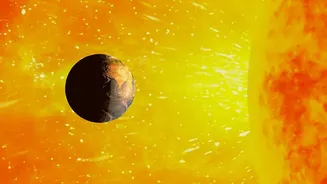
as solar flares and coronal mass ejections (CMEs). If a powerful CME is aimed at Earth, it can slam into our planet's magnetic field, triggering a geomagnetic storm. While these storms don't harm humans directly on the ground, they can induce powerful electrical currents in our infrastructure, threatening to overload power grids, damage pipelines, and disrupt telecommunications. A severe event, like the 1859 Carrington Event, could cause widespread, long-lasting blackouts and knock out GPS and radio communications today.
A Race Against Time
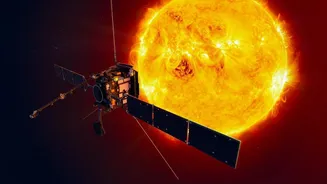
For decades, predicting exactly when and where a geomagnetic storm will impact Earth has been a major challenge. Satellites can see a CME leaving the Sun, but forecasting its effects on Earth has been slow and imprecise. Previous models that used physics-based simulations were often too slow to provide a meaningful warning, while others could only give forecasts for specific, localized areas. With our global reliance on satellites for navigation, high-frequency radio for aviation, and stable power grids for, well, everything, the need for a faster, more accurate warning system has become critical. The goal has always been to get a heads-up—enough time to react before the storm hits.
Enter DAGGER: The AI Forecaster
This is where a new AI model called DAGGER comes in. The name stands for Deep Learning Geomagnetic Perturbation, and it was developed by an international team of researchers, including from India's Inter-University Centre for Astronomy and Astrophysics, through a public-private partnership with NASA. Unlike previous systems, DAGGER uses artificial intelligence to rapidly analyze real-time data from satellites that monitor the solar wind. By studying the connections between the solar wind and disturbances on Earth, the AI learns to predict the location and severity of a geomagnetic event anywhere on the globe.
How 30 Minutes Can Save Our Modern World
DAGGER's key advantage is its speed. It can generate a specific, worldwide forecast in less than a second and update it every minute, providing a crucial 30-minute warning before the storm's impact. Thirty minutes might not sound like much, but for infrastructure operators, it's a game-changer. This lead time allows power companies to re-route power or take sensitive transformers offline to prevent catastrophic overloads and permanent damage. Satellite operators can put their spacecraft into a protective safe mode or adjust their orbits to minimize risk. Airlines that fly over the polar regions, where the effects are strongest, can be rerouted to avoid communication blackouts and radiation exposure. This half-hour window is the difference between weathering the storm and suffering a crippling technological blackout.
The Road Ahead for Space Weather Prediction
DAGGER has been successfully tested against data from past solar storms in 2011 and 2015, proving its accuracy. The model is open-source, meaning power companies, satellite operators, and telecommunication firms can integrate and adapt it for their specific needs. This is especially timely, as the Sun is heading towards a peak in its 11-year activity cycle, known as the solar maximum, which means the likelihood of strong storms is increasing. While the AI is a massive leap forward, it’s not perfect. It relies on data from past events, and we have thankfully avoided a truly catastrophic Carrington-level storm in the modern era, meaning the AI hasn't been trained on a worst-case scenario. Even so, DAGGER represents a fundamental shift in our ability to defend against one of nature's most powerful threats.