




What Makes a Planet 'Superhabitable'?
The idea of a superhabitable world was introduced by scientists who questioned our geocentric bias — the assumption that Earth is the best possible planet for life. Instead of looking for an exact twin of our world, they identified a set of criteria for a planet that could
be even more hospitable, supporting a richer and more diverse biosphere. These are not just habitable planets; they are worlds where the conditions for life's emergence and evolution are potentially superior to our own. A 2020 study led by geobiologist Dirk Schulze-Makuch identified 24 potential candidates out of thousands of known exoplanets that might fit this description.
Why Bigger Can Be Better
The headline's question points to a key factor: size. A planet that is slightly larger and more massive than Earth could have significant advantages. A planet around 1.5 times Earth's mass would have stronger gravity, making it better at holding onto a thick, protective atmosphere over billions of years. This increased mass also means it would likely retain its internal heat for longer. This is crucial for driving long-term geological activity like plate tectonics, which recycles minerals and helps regulate the climate, processes thought to be essential for sustaining life over geological timescales.
Orbiting the Right Kind of Star
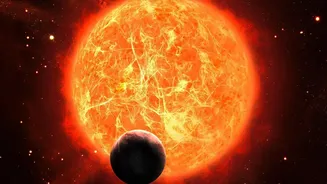
The perfect home needs the perfect host. Our sun, a G-type star, has a lifespan of about 10 billion years. While that sounds long, it took nearly 4 billion years for complex life to appear on Earth. Many G-type stars might run out of fuel before complex life gets a chance. Scientists suggest that K-type dwarf stars, often called 'Goldilocks stars', might be better hosts. They are cooler and less luminous than our sun but have incredibly long lifespans, ranging from 20 to 70 billion years. This provides a much longer, more stable window for life to not only begin but to evolve into complex forms.
The Other Key Ingredients
Beyond size and star type, other factors play a role. A superhabitable planet would likely be slightly older than Earth — the sweet spot is estimated to be between 5 and 8 billion years old, giving complex life more time to develop. It would also be slightly warmer and wetter. An average temperature about 5 degrees Celsius higher than Earth's could foster greater biodiversity. Abundant water is key, but instead of vast, deep oceans, a world with more archipelagos and shallow seas would create a mosaic of different habitats, potentially leading to richer ecosystems.
Are There Any Real Candidates?
This isn't just theory. Of the thousands of exoplanets discovered, scientists have flagged a few as intriguing contenders, although all are over 100 light-years away. One of the most promising candidates mentioned in studies is KOI 5715.01, a planet orbiting a K-type star. It's estimated to be about 5.5 billion years old and has a diameter roughly 1.8 to 2.4 times that of Earth. While none of the identified planets tick every single box for superhabitability, they represent tantalising targets for future observation with advanced instruments like the James Webb Space Telescope. These candidates push us to broaden our search and imagine the incredible variety of worlds the universe may hold.