






The Shadow Problem in Space
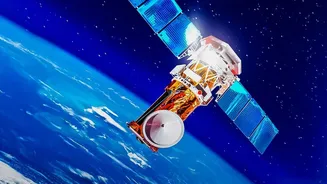
For any satellite orbiting the Earth, studying the Sun comes with a persistent challenge: our own planet. A spacecraft in a typical Low Earth Orbit (LEO) passes into Earth's shadow for a significant portion of its journey. During these periods, known
as eclipses or occultations, the satellite's view of the Sun is completely blocked. This creates frustrating interruptions in data collection, making it difficult to study solar events that evolve over hours or days, such as the build-up to a solar flare or the journey of a coronal mass ejection (CME). To truly understand the Sun's dynamic behaviour, scientists need a constant, unwavering gaze—something an Earth orbit simply cannot provide. This is the core problem that ISRO’s Aditya-L1 mission was designed to solve.
A Point of Perfect Balance
The solution is not just about distance, but about physics. Aditya-L1 is positioned at a special spot in space known as Lagrange Point 1, or L1. Named after the mathematician Joseph-Louis Lagrange, these are five points in any two-body system (like the Sun and Earth) where the gravitational forces and orbital motion balance out. Specifically, at the L1 point, located about 1.5 million kilometres from Earth along the line to the Sun, the gravitational pull of the Sun is partially cancelled out by the gravitational pull of the Earth. This creates a point of gravitational equilibrium, allowing a spacecraft to essentially 'hover' in a fixed position relative to both celestial bodies with minimal fuel needed for station-keeping. This location is the perfect outpost for a solar observatory.
The Ingenious Halo Orbit
However, Aditya-L1 isn't parked statically at the L1 point. Instead, it traces a complex, three-dimensional path around it called a 'halo orbit'. This orbit is a delicate, periodic loop that the spacecraft traces roughly every 178 days. This clever orbital manoeuvre is the key to its uninterrupted view. By orbiting around L1, the spacecraft ensures that it is never directly behind the Earth or the Moon. Even though the L1 point lies on the direct line between the Sun and Earth, the halo orbit's wide path keeps Aditya-L1 from ever entering their shadows. This guarantees a continuous, 24/7 sightline to the Sun, something that would be impossible from a simple Earth orbit. It's an elegant solution that provides the stability of the L1 point with the practical advantage of avoiding all eclipses.
An Unblinking Eye on the Sun
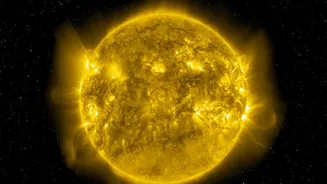
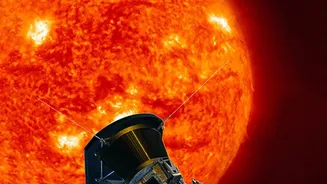
This constant sightline is what makes Aditya-L1's science so powerful. With its seven sophisticated payloads, the observatory can watch solar phenomena unfold without interruption. Four of its instruments directly observe the Sun's photosphere, chromosphere, and corona. For example, its main payload, the Visible Emission Line Coronagraph (VELC), creates a permanent artificial eclipse to study the faint solar corona. This allows it to capture the complete lifecycle of events like solar flares and CMEs—from their initial build-up to their explosive eruption. Recently, data from its SUIT and X-ray instruments helped identify small brightening events that act as early warnings for major flares. This continuous stream of data provides a comprehensive picture of the Sun’s dynamics, which is crucial for solving major mysteries like coronal heating.
Why This Matters for Us
Aditya-L1's mission is not just academic; it's vital for our technology-dependent life on Earth. The solar flares and CMEs it monitors are the primary drivers of space weather. These powerful eruptions can send torrents of charged particles and radiation towards Earth, capable of disrupting communication satellites, damaging power grids, and interfering with GPS navigation. By being at L1, Aditya-L1 can detect these 'solar storms' as they leave the Sun, giving Earth an advance warning of about a day before they arrive. This early-warning capability is essential for taking protective measures, such as putting satellites in safe mode or rerouting flights. Ultimately, Aditya-L1’s constant vigil helps safeguard the critical infrastructure that powers our modern world.