


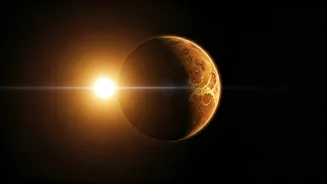



Two Kinds of 'Day'
Before we dive into Mercury's weirdness, let's clarify what a 'day' even means. On Earth, we barely notice the difference between two types of days. The first is a 'sidereal day,' which is the time it takes for a planet to complete one full 360-degree
rotation on its axis. For Earth, this is about 23 hours and 56 minutes. The second is a 'solar day,' the time it takes for the Sun to appear in the same position in the sky—what we call 24 hours. That extra four minutes is the time it takes for Earth to rotate a little bit more to 'catch up' because it's also moving along its orbit around the Sun. This distinction is tiny for us, but for Mercury, it’s everything.
Mercury's Slow Spin
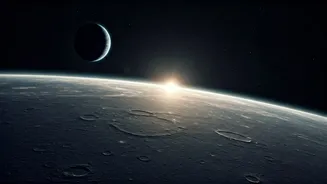
The headline gets straight to the point: Mercury takes a very long time to spin. One full rotation—its sidereal day—is approximately 58.6 Earth days. So, if you were standing on Mercury, it would take nearly two Earth months for the planet to complete a single turn. For decades, astronomers believed Mercury was 'tidally locked' to the Sun, meaning one side always faced the Sun, just as the same side of our Moon always faces Earth. But in 1965, radar observations proved this wrong. Mercury isn't fully locked, but it is in a unique and stable rhythm that governs its strange timing.
A Day Longer Than Its Year
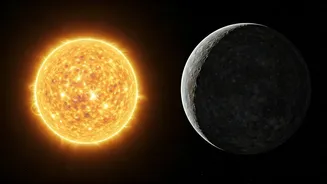
This is where things get truly mind-bending. While Mercury's rotation (sidereal day) is 59 Earth days, its solar day—the time from one sunrise to the next—is a whopping 176 Earth days long. To put that in perspective, Mercury orbits the Sun in just 88 Earth days. This means a single day on Mercury is twice as long as its entire year! You could celebrate two full birthdays on Mercury in the time it takes to experience one sunrise and one sunset. During this long day, the surface temperature can soar to a scorching 430°C. During the equally long night, it plummets to a freezing -180°C, one of the most extreme temperature swings in the solar system.
The Cosmic Dance: A 3:2 Resonance
So why is Mercury's day-year relationship so strange? The answer lies in a phenomenon called spin-orbit resonance. Because Mercury is so close to the Sun, the star's immense gravity exerts a strong tidal pull on it. This gravitational friction slowed Mercury's rotation down over billions of years. However, Mercury’s orbit isn't a perfect circle; it’s highly elliptical. This combination of a strong gravitational pull and an eccentric orbit caused it to settle into a stable 3:2 resonance. This means that for every two orbits it completes around the Sun (2 x 88 = 176 days), it rotates on its axis exactly three times (3 x 58.6 ≈ 176 days). This perfect, clockwork-like cosmic dance is the reason its solar day is precisely two of its years long. It’s a gravitational balancing act on a planetary scale.