
The Clockwork Cosmos
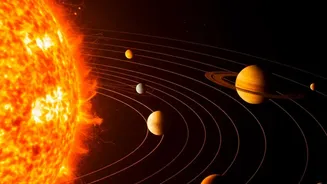
Since the days of Isaac Newton, the prevailing view of our solar system has been one of remarkable stability. The massive gravitational pull of the Sun keeps everything in a predictable dance, with the planets following their prescribed orbits. For generations,
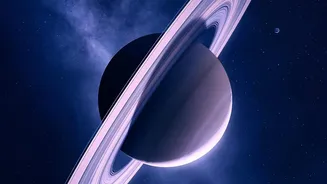
scientists believed this elegant arrangement would last for an almost unimaginable time—potentially trillions or even a quintillion years, long after our Sun burns out. Early computer models seemed to confirm this, showing that the giant planets like Jupiter, Saturn, Uranus, and Neptune would likely remain in their stable paths until a passing star eventually disturbed them billions of years in the future. This picture of cosmic permanence has been foundational to our understanding of our place in the universe.
A New Wrinkle in Gravity
Recent studies, however, are painting a different and more dynamic picture. A paper from researchers at the California Institute of Technology and the University of Michigan suggests the solar system's end might be much sooner and more chaotic. The key difference lies in how our Sun is expected to die. Instead of assuming the Sun will lose its mass smoothly as it transitions into a red giant and then a white dwarf, the new models consider a messier process. They simulate the Sun shedding its mass in uneven, violent bursts. These bursts would create 'kicks' that could nudge the giant planets, subtly altering their gravitational balance.
The Slow Dance of Chaos
This new understanding dramatically shortens the timeline for stability. According to hundreds of simulations run by the researchers, the old model of stability holds true only if the Sun's mass loss is perfectly smooth. But when factoring in the chaotic, burst-like mass ejections, the outer solar system's fate changes entirely. The simulations show that there's a significant chance of disruption long before previously thought. Instead of lasting for quintillions of years, the models predict that the orbits of the giant planets could become unstable within just a few billion years after the Sun becomes a white dwarf. One study suggests that roughly 90% of their simulated systems broke down within three billion years. This doesn't mean our solar system is in imminent danger; these events are still slated for a future that is billions of years away, long after the Sun's expansion has likely engulfed Earth.
Jupiter's Pivotal Role
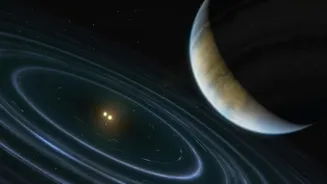
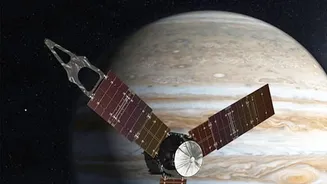
At the heart of this cosmic dance is Jupiter. As the most massive planet in our solar system, its gravitational influence is immense and acts as a stabilizing—or destabilizing—force. Even now, the intricate gravitational interplay between Jupiter, Saturn, and Uranus is understood to be technically chaotic, though stable over human timescales. The new research highlights that as the Sun's mass changes, the gravitational balance it currently enforces will weaken, amplifying the subtle nudges between the giant planets. This could eventually push their orbits into more eccentric, or oval-shaped, paths, leading to a period of 'violent scattering' where planets could be ejected from the solar system entirely.
Beyond Our Cosmic Backyard
These findings do more than just rewrite the final chapter of our own solar system. They provide a valuable lens for understanding the thousands of other planetary systems, or exoplanets, that astronomers are discovering across the galaxy. Many of these distant systems appear to be far more chaotic than our own, with 'hot Jupiters' orbiting perilously close to their stars and planets on highly irregular orbits. By understanding the mechanisms that can lead to instability here, scientists can build better models to predict how other systems form, evolve, and whether they might host stable, Earth-like worlds. It reinforces the idea that planets are not static objects but part of a dynamic, ever-evolving cosmic environment.