


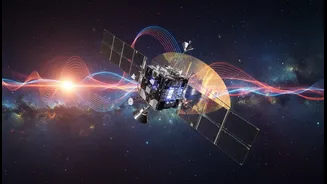


Our Unpredictable Star
Space weather refers to the ever-changing conditions in space, driven almost entirely by the Sun. Think of the Sun not as a steady, gentle warmth, but as a turbulent star that has moods. It releases a constant stream of charged particles called the solar
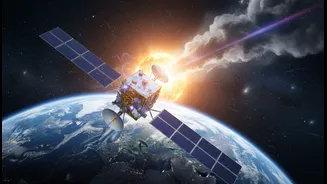
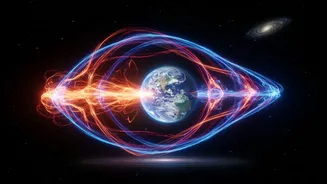
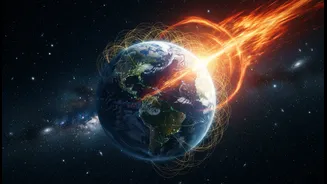
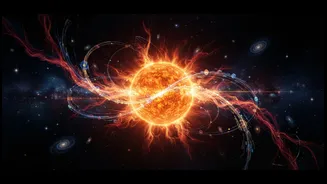
wind. More violently, it can unleash solar flares—immense explosions of radiation—and coronal mass ejections (CMEs), which are massive clouds of plasma and magnetic fields hurled into space. When these events are aimed at Earth, they can have significant disruptive effects on our technology-dependent society. While our planet's magnetic field, the magnetosphere, protects us from most of this, powerful storms can still break through.
Satellites in the Firing Line
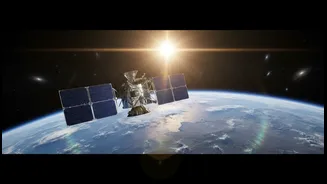
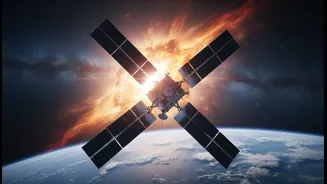
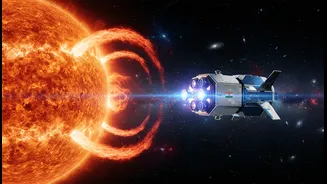
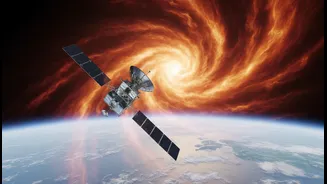
Satellites are particularly vulnerable because they operate outside the full protection of Earth's atmosphere. The effects of space weather on these orbital assets can range from inconvenient to catastrophic. Solar radiation can damage sensitive electronics, cause phantom commands that make a satellite misbehave, and degrade solar panels, shortening a mission's life. A strong solar storm can also heat and expand Earth's upper atmosphere. This increases atmospheric drag on satellites in low-Earth orbit, causing them to lose altitude and potentially fall out of orbit entirely—as famously happened to a batch of Starlink satellites in 2022. Furthermore, disruptions to the ionosphere can degrade or block GPS and communication signals, affecting everything from aviation to precision agriculture.
The Art and Science of the Forecast
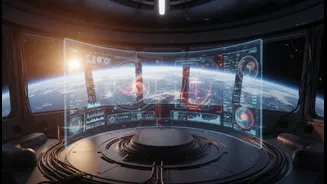
So, how do you predict a solar storm? Forecasters at agencies like NOAA's Space Weather Prediction Center (SWPC) act like solar meteorologists. They use a vast network of ground-based telescopes and space-based satellites to monitor the Sun in real-time. They analyse features like sunspots—dark, complex regions on the Sun's surface that are often precursors to solar flares. Advanced observatories watch for the initial signs of a CME. Data from satellites positioned between the Sun and Earth, like the ACE satellite, provides crucial information about the incoming solar wind, sometimes giving hours or days of warning before a geomagnetic storm hits. Still, the science is young; forecasting space weather is said to be where terrestrial weather forecasting was 50 years ago.
A New Front for India
With a rapidly growing space program and increasing reliance on satellite services, India is taking the threat of space weather seriously. The Indian Space Research Organisation (ISRO) is bolstering its monitoring capabilities. The Aditya-L1 mission, India's first dedicated solar observatory, is positioned at the L1 Lagrange point to get a continuous view of the Sun. Its instruments have already been observing solar flares and CMEs, providing valuable data for Indian scientists. On the ground, projects like the Indian Network for Space Weather Impact Monitoring (INSWIM) track the effects on our atmosphere. Recently, Indian researchers even developed a new method to more accurately map the ionosphere over the region, which is crucial for improving navigation systems like NAVIC. This is not just a scientific pursuit; it is a matter of national security and economic stability. Protecting our assets in space is critical for everything from disaster management to digital payments.
The Trillion-Dollar Threat
The stakes are incredibly high. The modern economy is so intertwined with space-based technology that a severe solar storm could have a devastating impact. Studies have estimated that the potential global economic loss from an extreme event could run into the trillions of dollars. A report from Lloyd's of London highlighted the risk, noting that a single major storm could disrupt power grids, communications, and financial systems for an extended period. This has elevated space weather from a niche scientific interest to a serious national risk in many countries. As a result, the ability to forecast these events and take mitigating action—such as temporarily shutting down satellite components or adjusting power grid loads—is becoming an invaluable skill for governments and commercial operators worldwide.