



A Day Longer Than a Year
Let's break down this cosmic paradox. A year is the time it takes a planet to complete one orbit around its star. A day is the time it takes to spin once on its axis. Here on Earth, that’s roughly 365 days in a year. Simple. Venus, however, plays by its own rules.
It zips around the Sun in just 225 Earth days, making its year significantly shorter than ours. But when it comes to spinning on its axis—a single day—Venus is incredibly sluggish. It takes a staggering 243 Earth days to complete one rotation. So, if you were standing on Venus, you would finish a full trip around the Sun (a Venusian year) before you even experienced one full spin of the planet (a Venusian day). It’s one of the most peculiar facts in our solar system, turning our fundamental concept of time upside down.
The Planet That Spins Backwards
The oddities don’t stop there. Not only is Venus’s rotation incredibly slow, it’s also backwards. Most planets in our solar system, including Earth, spin counter-clockwise on their axis. This is known as prograde rotation. If you look down on the solar system from above the Sun's north pole, you’d see almost everything spinning in the same direction. But Venus is a rebel. It has a retrograde rotation, meaning it spins clockwise. On Venus, the Sun would appear to rise in the west and set in the east. This backward spin, combined with its slow speed, creates another mind-bending effect. The time between one sunrise and the next, called a solar day, is about 117 Earth days. So while a single spin takes 243 days, you’d only have to wait 117 days for the sun to return to the same spot in the sky.
Why Is Venus So Strange?
Scientists don't have a single definitive answer, but they have compelling theories. The leading hypothesis for Venus’s bizarre rotation involves a cataclysmic event deep in its past. Early in the solar system's history, when planets were still forming, it’s possible that a massive, planet-sized object smashed into Venus. Such a colossal impact could have been powerful enough to not just dramatically slow its original rotation but actually flip it completely upside down. What we see as a backward spin could be an inverted planet spinning in the 'correct' direction. Another contributing factor is its incredibly thick and heavy atmosphere. This dense blanket of gas, about 90 times the pressure of Earth's, creates powerful atmospheric tides. Over billions of years, the gravitational pull of the Sun on this dense atmosphere could have acted like a brake, slowing the planet’s spin to its current crawl.
Earth's Twisted Sister Planet
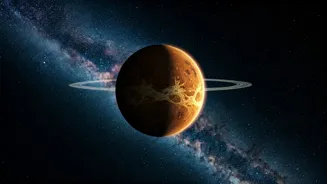
Venus is often called Earth’s twin. It's similar in size, mass, and composition, and it's our closest planetary neighbour. But the similarities end there. Its surface is a hellscape, with temperatures averaging around 465°C—hot enough to melt lead—and crushing atmospheric pressure. It’s a toxic, scorched world that serves as a powerful cautionary tale. Scientists believe Venus may have once been much more like Earth, with liquid water oceans. However, a runaway greenhouse effect took hold, boiling the oceans away and trapping heat, turning it into the inferno we see today. Studying Venus is therefore crucial for understanding planetary climates. It provides a natural laboratory for what happens when a greenhouse effect spirals out of control, offering vital insights into the delicate balance that makes a planet habitable and helping us better model and protect Earth’s own climate.