




A Survivor's Story
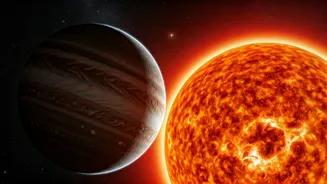
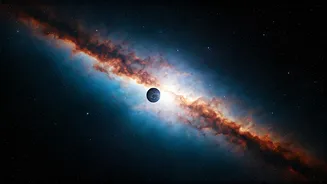
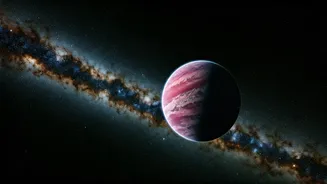
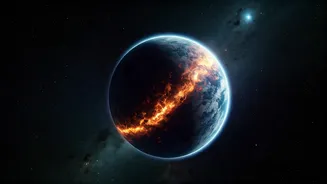
The planet at the center of this cosmic conversation is WD 1856 b, a gas giant roughly the size of Jupiter, located about 80 light-years from Earth. What makes this world so extraordinary is not just its size, but its landlord: a white dwarf, which is the tiny,
super-dense remnant of a star that was once like our Sun. Billions of years ago, its star swelled into a red giant, a phase that should have completely incinerated any nearby planets. Yet, WD 1856 b is still here, orbiting its dead star at an astonishingly close distance—completing a full year in just 34 hours. This bizarre arrangement had astronomers stumped since its discovery in 2020, but Webb's new observations are finally providing some answers.
Reading the Alien Atmosphere
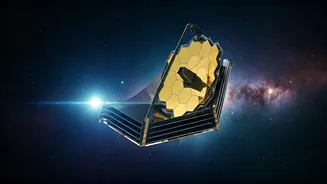
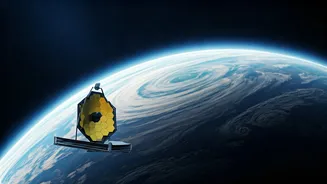
Using its powerful infrared instruments, the James Webb Space Telescope (JWST) analyzed the starlight filtering through the planet's atmosphere as it passed in front of the white dwarf. This technique, called transit spectroscopy, allows scientists to identify the chemical fingerprints of molecules present. For the first time on a planet orbiting a dead star, Webb detected an atmosphere. The data revealed the distinct signatures of hydrocarbons, most likely methane, along with a haze of small cloud particles. This finding alone is a monumental achievement, proving that planets can not only survive their star's death but also retain an atmosphere for billions of years.
A World That's Hotter Than It Should Be
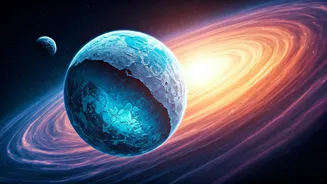
The Webb data delivered another major surprise: the planet’s temperature. Scientists measured it at about 126 degrees Celsius, which is significantly hotter than it should be based on the faint light from its white dwarf star. This finding turned out to be the key to understanding the planet's past. The research team concluded that this excess heat is residual energy from a much more dramatic period in the planet's history. The most likely scenario is that the planet migrated inward from a much more distant orbit long after its star died. As it spiraled closer, the immense gravity of the white dwarf squeezed and flexed the planet, generating massive amounts of internal heat. The planet is now slowly cooling off from that violent gravitational massage.
A Glimpse into Our Solar System's Future
The story of WD 1856 b is more than just a fascinating tale of a distant world; it's a preview of our own solar system's distant future. In about five billion years, our Sun will also exhaust its fuel, expand into a red giant, and then collapse into a white dwarf. While inner planets like Earth will likely be destroyed, this discovery suggests that gas giants like Jupiter and Saturn could survive. They might even migrate into new, closer orbits, creating a radically reconfigured solar system long after the Sun has died. As lead author Ryan MacDonald stated, it's like using a time machine to peer into the future. Webb's ability to study these post-death planetary systems opens a brand-new field of astronomy, exploring the surprising second acts of solar systems across the galaxy.