




Unpacking the Bizarre Timeline
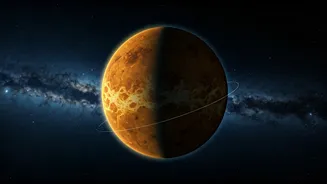
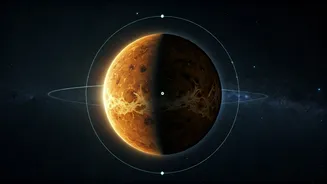
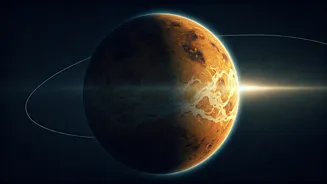
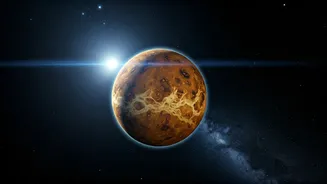
Let's get the numbers straight because they are truly mind-bending. Venus takes about 225 Earth days to complete one full orbit around the Sun. This is its 'year'. However, it takes the planet a staggering 243 Earth days to complete one rotation on its axis.
This is its 'sidereal day'—the time it takes to spin 360 degrees relative to the distant stars. So, quite literally, a single day of rotation on Venus lasts longer than its entire year.
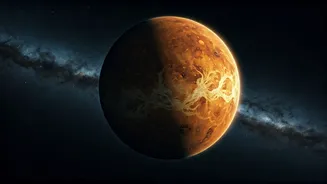
But wait, it gets even weirder. If you were standing on Venus (which you can't, due to the crushing pressure and lead-melting heat), you wouldn't experience a day-night cycle that lasts 243 days. Because the planet is also moving around the Sun, the time from one sunrise to the next—a 'solar day'—is much shorter, about 117 Earth days. This means a Venusian would experience two sunrises in a single Venusian year, with each period of daylight and darkness lasting for nearly two Earth months.
Spinning the Wrong Way
As if a day longer than its year wasn't strange enough, Venus also spins backwards. All the planets in our solar system orbit the Sun in the same direction, and most of them also rotate on their axis in that same direction (counter-clockwise, if you look down from above the Sun's north pole). But not Venus. It has a retrograde rotation, meaning it spins clockwise.
This means that on Venus, the Sun rises in the west and sets in the east. This backward, leisurely spin makes Venus the outcast of the solar system's planetary family. Only Uranus, which is knocked on its side and essentially rolls along its orbit, has a similarly non-conformist rotation. This fundamental difference is a major clue that something dramatic happened in Venus’s distant past.
Why is Venus So Slow and Backwards?
Scientists don't have a single, definitive answer, but there are two main theories that try to explain Venus’s bizarre behaviour. The first is the 'giant impact' theory. In the chaotic early days of the solar system, protoplanets were constantly colliding. It’s possible that a massive, planet-sized object smashed into a young Venus, not only slowing its original spin to a near-standstill but also knocking it into its current retrograde, or backward, rotation.
The more recent and widely supported theory, however, points to Venus's own atmosphere. Venus has an incredibly thick, dense atmosphere—about 90 times thicker than Earth’s—composed mainly of carbon dioxide. This heavy blanket of gas creates powerful 'atmospheric tides'. Over billions of years, the gravitational pull of the Sun on this dense atmosphere could have created enough friction and drag to slow the planet's rotation down from a much faster, more 'normal' spin, and eventually even reverse it. Think of it as a giant, planetary-scale air brake that has been applied for eons.
A World Shaped by a Slow Spin
This slow, backward rotation isn't just a quirky piece of trivia; it fundamentally shapes the environment of Venus. On Earth, our relatively fast 24-hour rotation helps distribute the Sun's energy, creating weather systems, ocean currents, and a significant temperature difference between the equator and the poles. Venus doesn't have that luxury.
With a day-night cycle lasting months, you might expect the night side to cool down significantly. But the super-thick greenhouse atmosphere traps heat with terrifying efficiency. It circulates the heat so effectively that there's very little temperature difference between day and night, or between the equator and the poles. The entire planet is locked in a permanent, sweltering heatwave of around 465°C. This hellish, uniform temperature, combined with crushing atmospheric pressure and clouds of sulphuric acid, is a direct consequence of the planet's unique atmospheric and rotational combination.