



A Portrait of Deep Time
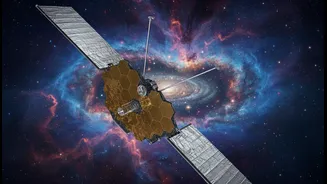
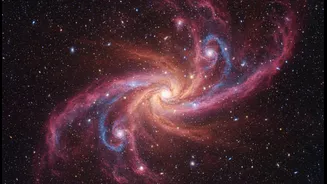
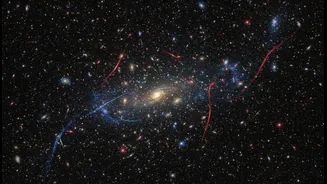
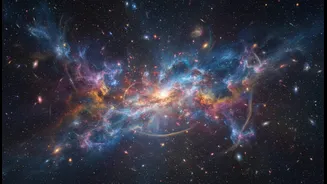
The most famous of these images is Webb’s First Deep Field, centered on a galaxy cluster known as SMACS 0723. It’s a cosmic tapestry filled with thousands of galaxies. Some are relatively close, shining brightly with distinct shapes. Others are mere smudges
of ancient light, the faintest objects ever observed in the infrared. The sheer density of objects is staggering. The entire patch of sky captured in the image is no bigger than a grain of sand held at arm's length. Within that tiny window, Webb revealed not just a few new galaxies, but a bustling metropolis of cosmic structures stretching back through time. This single image shows the galaxy cluster as it was 4.6 billion years ago, while also capturing light from galaxies that is over 13 billion years old.
Gravity's Magnifying Glass
Look closely at the image and you’ll notice something strange: many of the galaxies appear stretched, warped, and curved into bizarre arcs. This isn't an error or a camera glitch. It's the visual proof of one of Albert Einstein's most mind-bending theories: gravitational lensing. The combined mass of the SMACS 0723 cluster is so immense that it literally warps the fabric of spacetime around it. As light from even more distant galaxies travels past the cluster on its way to us, its path is bent by this warped spacetime. The cluster acts as a natural, cosmic magnifying glass, amplifying and distorting the light from behind it. This effect allows astronomers to see galaxies that would otherwise be far too faint and distant for any telescope to detect on its own.
A Cosmic Time Machine
Because light travels at a finite speed, looking far out into space is the same as looking back in time. The light from the most distant galaxies in the Webb deep field has been traveling for over 13 billion years to reach us. We are seeing them as they were when the universe was in its infancy, less than a billion years after the Big Bang. Before Webb, our views of these primordial galaxies were blurry at best. Now, thanks to the telescope’s infrared sensitivity and the boost from gravitational lensing, we can see them in sharp focus. We can make out tiny, faint structures like star clusters and diffuse features that have never been seen before, giving us unprecedented clues about how the first galaxies formed and evolved.
Unlocking Ancient Secrets
These images are far more than just pretty pictures. Embedded in the light from each galaxy is a wealth of information. Using instruments like the Near-Infrared Spectrograph (NIRSpec), scientists can spread the light out into its constituent wavelengths, like a rainbow. This process, called spectroscopy, acts like a chemical fingerprint reader for the cosmos. It reveals the composition, temperature, mass, and age of these ancient galaxies. Webb’s data can show what elements were present in the early universe, revealing the building blocks of the first stars and galaxies. For the first time, scientists are getting detailed chemical profiles of galaxies from the dawn of time, helping to piece together the grand story of cosmic evolution.
The Science of Awe
Ultimately, the power of Webb’s galaxy cluster views lies in their ability to connect us to these immense cosmic scales. They are a testament to human ingenuity—a telescope so powerful it can use gravity itself as a tool. But they also tap into something more fundamental: our capacity for wonder. These images blur the line between science and art, revealing a universe that is not only mathematically elegant but also breathtakingly beautiful. They show us that even in a tiny sliver of the sky, there are thousands of entire galaxies, each containing billions of stars. It’s a perspective that is both humbling and inspiring, a reminder of the vast, unexplored territory that still awaits us and the profound questions we have yet to answer.