




The Ultimate Safety Net
At its heart, the Gaganyaan mission is about safely sending humans to a 400-km orbit and returning them to Earth. While the launch itself is a monumental task, ensuring the crew can escape a failing rocket is arguably more important. This is where the Crew
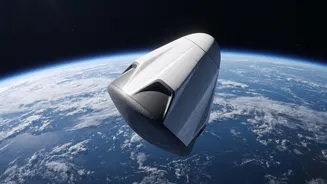
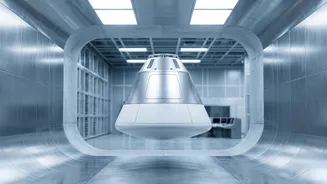
Escape System (CES) comes in. Think of it as the most advanced ejection seat ever built, but instead of ejecting a single pilot, it’s designed to pull the entire crew module—the capsule carrying the astronauts—away from an exploding or malfunctioning launch vehicle in milliseconds. The system must be powerful enough to outrun a disaster, pulling the multi-tonne module to a safe altitude before it deploys parachutes for a soft landing. This isn't a 'nice-to-have' feature; it is the absolute bedrock of astronaut safety.
Rehearsing for Disaster
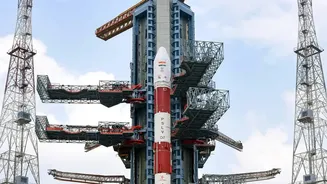
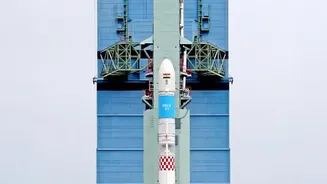
A rocket launch is a controlled explosion, and failure can occur at any moment. ISRO has designed its abort tests to cover the most critical phases. The first is a 'Pad Abort', which simulates an emergency on the launchpad itself, before or during ignition. ISRO successfully demonstrated this in 2018, where the CES lifted a simulated crew module to an altitude of 2.7 km before safely splashing down. The second, more complex scenario is an 'In-flight Abort'. This test simulates a failure after the rocket has already taken off and is travelling at high speed. The Test Vehicle Abort Mission-1 (TV-D1), conducted in October 2023, was designed for this exact purpose. It tested the escape system's ability to function at transonic speeds—around Mach 1.2—where the aerodynamic stress on the rocket is at its peak.
A Symphony of Systems
The abort tests are far more than just firing a rocket motor. They are a perfectly timed sequence of events that must execute flawlessly in seconds. First, the onboard computers must detect a critical anomaly in the launch vehicle. This triggers the CES, whose powerful solid-fuel motors ignite to pull the crew module away with immense force. Once at a safe distance, the escape system jettisons itself, and the crew module begins its own journey back to Earth. This involves deploying a series of drogue and main parachutes to slow the descent from high speed to a gentle splashdown. The TV-D1 mission, for example, saw the module splash down in the Bay of Bengal about 10 km from the coast, where it was successfully recovered by the Indian Navy, proving the end-to-end procedure.
Why Not Just Trust Simulations?
While computer models are essential for design, nothing can replace real-world testing when human lives are at stake. These tests provide invaluable data on how the hardware performs under extreme stress, from the firing of the escape motors to the deployment of the parachutes and the structural integrity of the crew module. The TV-D1 mission itself encountered a brief, real-life hold just moments before its initial launch attempt due to an engine anomaly detected by the onboard computer. This unexpected event was a successful demonstration in its own right, proving that the automated safety checks were working exactly as designed. Each test validates not just the escape system but the entire chain of command, from detection and separation to recovery. With future tests like TV-D2 planned, ISRO is meticulously building a mountain of evidence to prove the system's reliability.
The Promise to the Vyomanauts
Ultimately, these critical abort tests are a promise to the Indian Air Force pilots selected to become the nation's first Vyomanauts. Sending humans into space is an inherently risky endeavour, a fact underscored by historical spaceflight accidents. The only way to responsibly undertake such a mission is by preparing for the worst-case scenarios with obsessive rigor. For ISRO, successfully proving the Crew Escape System is a non-negotiable prerequisite before any astronaut boards the Gaganyaan spacecraft. These tests are the most tangible demonstration of ISRO's commitment to one overriding principle: in human spaceflight, crew safety is more important than mission success. Each successful abort test brings India one step closer to confidently and safely launching its own citizens into the stars.