






Getting Started: Your Basic Toolkit
Before you start bending and twisting, it’s helpful to have a few basic tools. You don’t need a lot to get started, and many items can be found at a local hardware or craft store. The essentials include a pair of wire cutters and a few types of pliers,
such as round-nose pliers for making loops and curves, and flat-nose pliers for bending sharp angles and gripping wire securely. As for the wire itself, it comes in various materials like copper, aluminum, and steel, and in different thicknesses, or gauges. A lower gauge number means a thicker wire. For beginners, a medium-gauge, flexible copper or aluminum wire is a great starting point because it’s easy to shape by hand but still holds its form.
Project 1: Minimalist Wire Wall Art
One of the easiest and most impactful projects is creating wire word art or simple line drawings for your walls. Think of a favorite word, a simple cursive name, or a minimalist shape like a face profile or an animal. To begin, you can sketch your design on a piece of paper to use as a template. Then, simply use your pliers and hands to bend the wire, following the lines of your drawing. A 16 or 18-gauge wire works well for this, as it's sturdy enough to maintain its shape on the wall but still pliable enough to work with. This project requires very little precision and allows for a lot of creative freedom, resulting in a custom piece of decor that is uniquely yours.
Project 2: Delicate Wire-Wrapped Jewelry
Wire is a fundamental material in jewelry making, and creating your own pieces is surprisingly simple. You can craft everything from elegant pendants and earrings to statement rings and bracelets. Wire wrapping is a popular technique that involves coiling thinner wire around a thicker base wire or bead. For simple earrings, you can shape 20-gauge wire into hoops or use round-nose pliers to create loops for attaching beads. For pendants, try wrapping a fine 24 or 26-gauge wire around a beautiful stone or piece of sea glass to create a secure and decorative frame. Copper wire is a favorite for jewelry as it's easy to work with and develops a beautiful patina over time.
Project 3: Whimsical 3D Sculptures
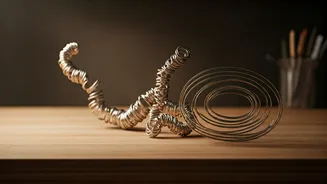
If you’re feeling more adventurous, try your hand at creating small, free-standing 3D sculptures. These can be as simple as a little stick figure, a spiral-based animal, or an abstract shape. Starting with a thicker wire for the main structure or “armature” can provide stability. You can then build upon it with thinner, more flexible wires to add details. A great first 3D project is a wire person, which teaches the basics of twisting and shaping for a head, body, and limbs. Another fun idea is a wire tree, starting with a bundle of wires twisted together for the trunk, which then branch out to form roots and a canopy. Don't be afraid to experiment; the charm of these sculptures often lies in their imperfections.
Project 4: Functional and Fun Home Accents
Your wire creations don't just have to be decorative; they can be functional, too. With a few simple twists, you can make unique items for your home. Consider crafting custom napkin rings by wrapping wire around a cylindrical object. Another popular idea is creating plant stakes or small trellises for your indoor pots; a simple heart or a spiraled cat shape can add a touch of personality to your greenery. You could also design whimsical photo holders with a coiled base and a looped top to display your favorite pictures. These small, useful projects are a fantastic way to practice your skills while adding a handmade touch to your living space.