









What is a Portfolio Career?
A portfolio career isn't just another name for freelancing; it's a strategic and curated approach to work. Instead of relying on a single 9-to-5 job, a professional builds a 'portfolio' of multiple income streams. This could be a mix of part-time roles,
freelance projects, consulting gigs, and personal business ventures. For a creative, this might look like being a graphic designer for a few clients, teaching an online course in animation, and selling prints of their personal artwork. Unlike traditional freelancing which can be a series of disconnected gigs, a portfolio career is about intentionally weaving together different strands of work that leverage a range of skills and passions. It is a conscious move away from being defined by one job title towards becoming a multi-faceted professional whose career reflects their diverse interests.
The Search for Autonomy and Creative Control
A primary driver for creatives choosing this path is the rejection of rigid corporate structures. Corporate environments, with their hierarchies and established processes, can sometimes stifle the very creativity they seek to employ. For many artists, writers, and designers, the freedom to choose which projects to take on, when and where to work, and how to approach a task is paramount. This desire for autonomy isn't about avoiding work; it's about taking ownership of it. A portfolio career allows creatives to curate their work life to align with their values and creative impulses, rather than fitting into a pre-defined corporate box. This level of control is often a powerful antidote to the burnout and disillusionment that can arise from a restrictive corporate job.
A Strategy for Continuous Growth
The single-employer model can sometimes lead to skill stagnation. Once an employee becomes proficient in their role, opportunities for learning can become limited. A portfolio career, by its very nature, demands continuous growth. Working across different sectors and projects allows creatives to constantly acquire new skills and fresh perspectives. For instance, a writer working on both marketing copy and a film script is exercising different creative muscles and expanding their capabilities. This variety not only keeps the work stimulating but also makes the individual more marketable and resilient. Each new project is a chance to learn something new, solve a different problem, and add another layer to their professional skill set.
Diversifying Income for Financial Resilience
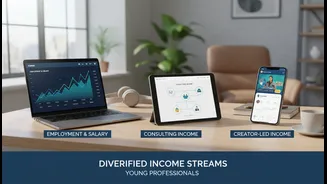
While it may seem counterintuitive, relying on multiple income streams can create a unique form of financial security. The traditional job model ties a person's entire financial well-being to one employer. A sudden redundancy can be catastrophic. In a portfolio career, the risk is spread out. If one stream of work dries up, others can sustain the individual. This diversification doesn't necessarily mean earning less; it means building a more resilient financial foundation. It's the financial equivalent of not putting all your eggs in one basket. This model provides a safety net that allows creatives to weather industry fluctuations and take calculated risks on passion projects that might not be immediately profitable.
The Unseen Challenges of Total Freedom
Despite its many attractions, the portfolio career is not without its difficulties. The freedom and flexibility come at a cost. Financial uncertainty can be a major source of stress, as income can be unpredictable. The individual is solely responsible for securing their own benefits, such as health insurance and retirement plans, which are standard in most corporate roles. It also requires immense self-discipline, time management, and the ability to constantly market oneself to find new opportunities. There is no boss to set priorities, which means juggling competing demands from different clients can be challenging. The potential for isolation is also real, as the camaraderie of a traditional office environment is absent.