



A New Martian Marathoner
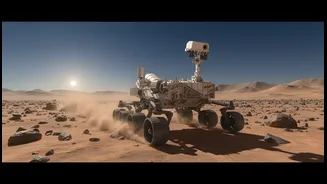
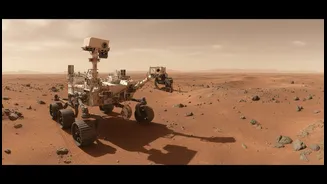
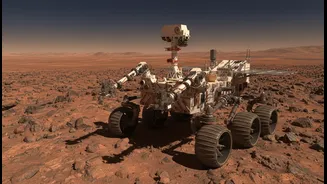
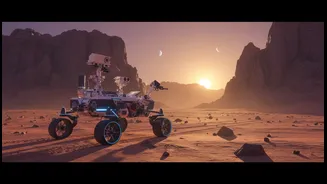
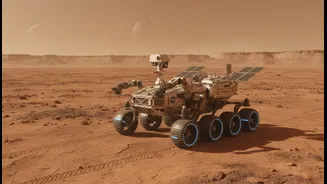
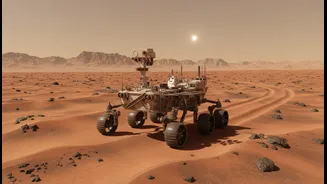
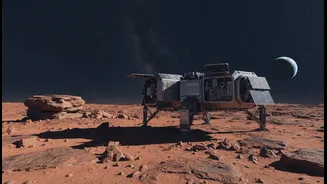
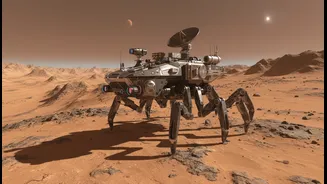
On June 14, 2026, the Perseverance rover officially crossed the marathon finish line, a milestone that took five years and four months to achieve. While it's the second robot to accomplish this feat on the Red Planet, its performance highlights a dramatic
acceleration in our exploratory capabilities. The first champion, the Opportunity rover, took a staggering 11 years and two months to cover the same distance back in 2015. Perseverance didn't just match the record; it shattered the timeframe, completing the journey in less than half the time. This isn't merely about setting records; it's a powerful demonstration of how far rover technology has evolved in a single decade, enabling more ambitious science in a shorter amount of time.
The Secret to Robotic Speed
The key to Perseverance's impressive pace lies in its brain. Unlike older rovers that required painstaking, step-by-step navigation from human operators on Earth, Perseverance is equipped with sophisticated autonomous driving software. This system, known as AutoNav, allows the rover to analyze the terrain ahead in real-time, make its own decisions about the safest and most efficient path, and drive with minimal human oversight. While Opportunity often had to wait for commands to be sent across millions of kilometers of space, Perseverance can 'think for itself' to avoid obstacles and continue moving. This ability to cover ground at nearly its top speed without constant hand-holding is what transforms it from a cautious crawler into a marathon runner, fundamentally changing the operational tempo of a Martian mission.
Science on the Move
This newfound speed directly translates into more scientific discoveries. Perseverance is on a mission in Jezero Crater, the site of an ancient lake and river delta, to search for signs of past microbial life. Covering a marathon's worth of ground means it has been able to survey a much wider and more geologically diverse area than would have been possible a decade ago. It has journeyed from the crater floor to the delta's western edge, analyzing rocks and collecting the most promising samples for a potential future return to Earth. Each kilometer driven opens up a new chapter of Martian history, and the ability to travel farther and faster dramatically increases the chances of making a landmark discovery within the mission's lifespan.
Standing on the Shoulders of a Giant
Perseverance's success was made possible by the incredible legacy of its predecessor, Opportunity. Originally designed for a 90-day mission, Opportunity survived for nearly 15 years, teaching NASA invaluable lessons about long-term survival on Mars. Its solar panels were surprisingly kept clean by Martian winds, and its engineers developed clever strategies to conserve power through harsh winters. However, its reliance on solar power ultimately led to its demise during a planet-encircling dust storm in 2018. Learning from this, engineers equipped Perseverance with a radioisotope thermoelectric generator (RTG), a nuclear power source that provides constant energy regardless of weather or season. This, combined with more robust wheels and advanced instrumentation, is a direct result of the lessons learned from Opportunity's heroic, long-distance trek.
The Next Leg of the Race
Completing a marathon is more than a symbolic victory; it's a critical field test for the future of planetary exploration. The technologies proven by Perseverance—especially its autonomous navigation and durability—are essential for upcoming missions like Mars Sample Return. This ambitious, multi-spacecraft campaign will require a rover to quickly travel to specific locations, retrieve the sample tubes left by Perseverance, and deliver them to a rocket that will launch them back to Earth. Such a complex operation demands the kind of speed and reliability that Perseverance has just demonstrated. Having already driven 42 kilometers, the rover has shown it is more than capable of handling the long road ahead, with engineers certifying its systems for many more kilometers of travel. Each drive solidifies confidence that our robotic explorers are ready for even greater challenges.