







More Than Just a Piece of Fabric
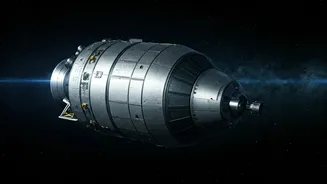
When the Gaganyaan crew module hurtles back to Earth, it relies on a perfectly choreographed sequence to slow down from hypersonic speeds to a gentle splashdown. This isn't the job of a single parachute, but a sophisticated system of ten parachutes of four
different types. This deceleration system is one of the most critical safety components of the entire mission. The complexity lies in ensuring each part deploys at the exact right moment, under extreme forces, to guarantee the crew's survival. Developing such a system is a monumental task in aerospace engineering, testing the limits of material science, pyrotechnics, and aerodynamic design.
A Symphony of Deceleration
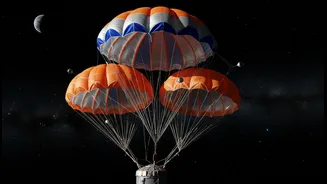
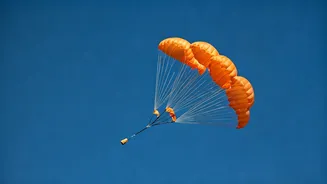
The landing sequence is a masterclass in controlled braking. It begins after the intense heat of re-entry, when two apex cover separation parachutes deploy to jettison the protective shield over the parachute compartment. This is followed by two drogue parachutes, which are conical in shape and designed to stabilise the fast-moving capsule and provide the first stage of significant deceleration. Once the module is stable, three smaller pilot parachutes are released. Their job is to pull out the three massive main parachutes. These main chutes are the final brakes, slowing the nearly five-tonne module to a safe landing speed of under 11 metres per second for its splashdown in the ocean.
A Made-in-India Collaboration
The successful development of this parachute sub-system is a testament to the power of Indian collaboration. It is a joint venture between the Indian Space Research Organisation (ISRO) and the Defence Research and Development Organisation (DRDO). Specifically, ISRO's Vikram Sarabhai Space Centre (VSSC) in Thiruvananthapuram, which leads launch vehicle development, worked hand-in-hand with DRDO's Agra-based Aerial Delivery Research and Development Establishment (ADRDE), a lab specialising in parachute technologies. Recent successful tests, like the Integrated Main Parachute Airdrop Test (IMAT), were joint efforts involving the Indian Air Force, which provided the IL-76 aircraft for drop tests. This multi-agency synergy is at the heart of the Make-in-India success story.
Rigorously Tested for Perfect Performance
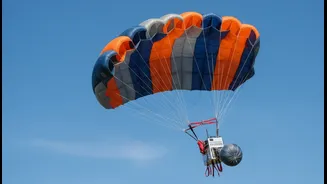
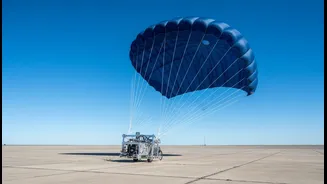
You don't send humans into space on untested hardware. The Gaganyaan parachute system has undergone a gruelling series of qualification tests to prove its reliability. These include airdrop tests where a dummy mass equivalent to the crew module is dropped from an aircraft at an altitude of 2.5 km. The most recent test on July 7, 2026, was the fifth in a series designed to qualify the main parachute under maximum expected loads, providing confidence for the first uncrewed Gaganyaan mission (G1). These tests validate everything from the pyro-based mortars that eject the parachutes to the structural integrity of the fabric and the complex reefing mechanism that allows the chutes to open in stages to avoid a catastrophic shock opening.
Strategic Self-Reliance in a Critical Field
Developing the parachute system indigenously goes far beyond just a single mission. It signifies a crucial step towards 'Aatmanirbharta' (self-reliance) in a niche and strategically vital area of aerospace manufacturing. Historically, such complex systems were often procured from a handful of space-faring nations. By developing this capability in-house, India not only saves significant foreign exchange but also builds a robust domestic ecosystem. It fosters expertise in advanced textiles, pyrotechnic devices, and systems integration. This project has also involved private sector players, like Hyderabad-based Manjira Machine Builders Pvt Ltd., who fabricated the simulated crew module structure, further deepening the nation's industrial capabilities for future space endeavours.