
The Sun's Turbulent Threat
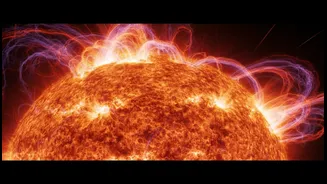
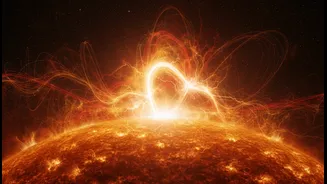
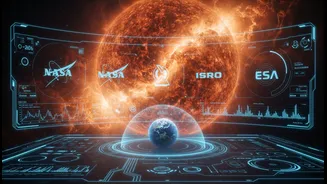
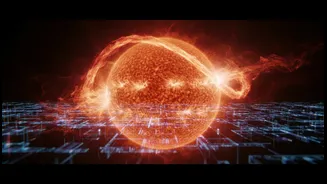
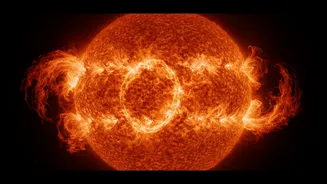
Our star is not always the calm, life-giving orb it appears to be. It periodically unleashes colossal explosions of energy, plasma, and magnetic fields known as solar flares and coronal mass ejections (CMEs). When these eruptions are aimed at Earth, they
can trigger geomagnetic storms. While these storms are responsible for the beautiful aurorae, they also pose a significant threat to our modern infrastructure. A severe event could induce powerful currents in power grids, leading to widespread blackouts like the one that struck Quebec in 1989. They can also damage or disable critical satellites, disrupting GPS navigation, banking systems, and telecommunications that are the backbone of a digital economy.
India’s Eye on the Sun
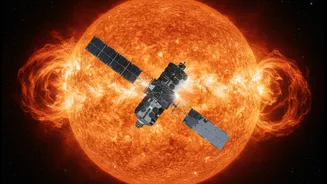
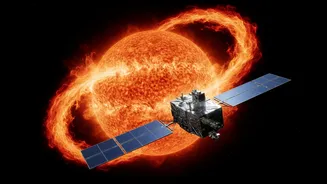
For a rapidly digitising nation like India, the stakes are enormous. Recognising this, the Indian Space Research Organisation (ISRO) has positioned itself at the forefront of solar observation. The Aditya-L1 mission, India's first dedicated solar observatory, is a crucial asset in this global effort. Stationed at Lagrange Point 1 (L1), a gravitationally stable spot about 1.5 million kilometres from Earth, Aditya-L1 has an uninterrupted view of the Sun. Its suite of instruments provides vital data on the Sun's atmosphere and the origins of solar eruptions, contributing to a better understanding of space weather dynamics. Recent studies using Aditya-L1 data have already provided breakthrough insights into how solar storms impact Earth's magnetic shield, demonstrating the mission's importance in safeguarding our space assets.
A Global Network of Sentinels
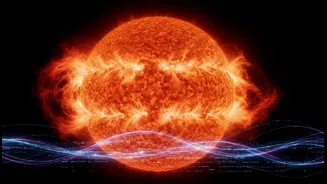
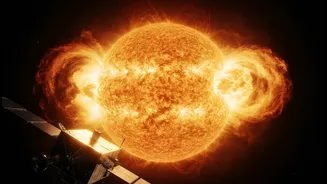
India is not alone in this endeavour. A new international fleet of space missions is bolstering our planetary defences. NASA's PUNCH mission, a constellation of four suitcase-sized satellites, launched in 2025 and is now creating unprecedented 3D maps of how the Sun's outer atmosphere, the corona, becomes the solar wind that flows past Earth. This helps scientists track CMEs with greater detail than ever before, improving forecasts. Looking ahead, the European Space Agency's (ESA) Vigil mission, planned for launch in 2031, will take up a unique position at the L5 Lagrange point. From this vantage point, it will see the side of the Sun before it rotates to face Earth, providing up to four or five days of advance warning for some solar events.
The Power of Prediction
These new instruments provide a firehose of data, but the real breakthrough lies in how we analyse it. Artificial intelligence and machine learning models are becoming indispensable tools for sifting through complex datasets to find patterns that precede a solar eruption. Recently, scientists also discovered a new method for predicting a solar cycle's strength up to seven years in advance by identifying a 'switch-off' point when extreme weather from the previous cycle abruptly stops. This long-range forecasting, combined with the near-term warnings from missions like Aditya-L1 and the future Vigil, represents a monumental leap in our predictive capabilities. Getting CME imagery and data to forecasters in 30 minutes instead of eight hours, as new systems like NOAA's SOLAR-1 are achieving, is a game-changer.
From Warning to Action
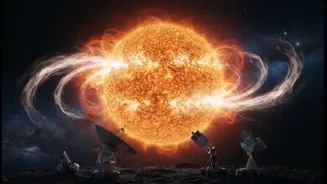
Improved warnings are not just an academic exercise; they enable concrete protective measures. With hours or days of notice, power grid operators can take steps to stabilise their networks and prevent cascading failures. Satellite operators can put their spacecraft into a safe mode, orienting them to protect sensitive electronics. Airlines can reroute flights to avoid communication blackouts and radiation exposure at high latitudes. This transition from basic monitoring to actionable intelligence is the core purpose of this new global space weather watch. The goal is to transform a potentially devastating natural hazard into a manageable event, safeguarding the technological infrastructure that underpins modern civilisation.