



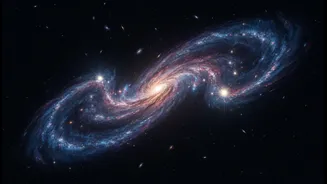


Meet the 'Cosmic Sparkler'
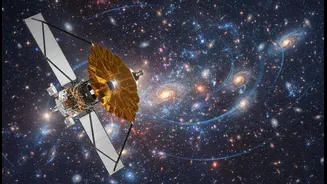
While there have been several breathtaking images from the Hubble Space Telescope nicknamed 'cosmic sparklers' recently, the term perfectly captures the essence of one of the most significant discoveries: a star so ancient its light has travelled for
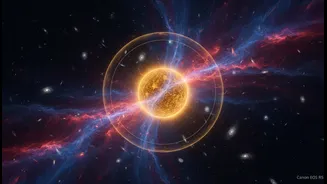
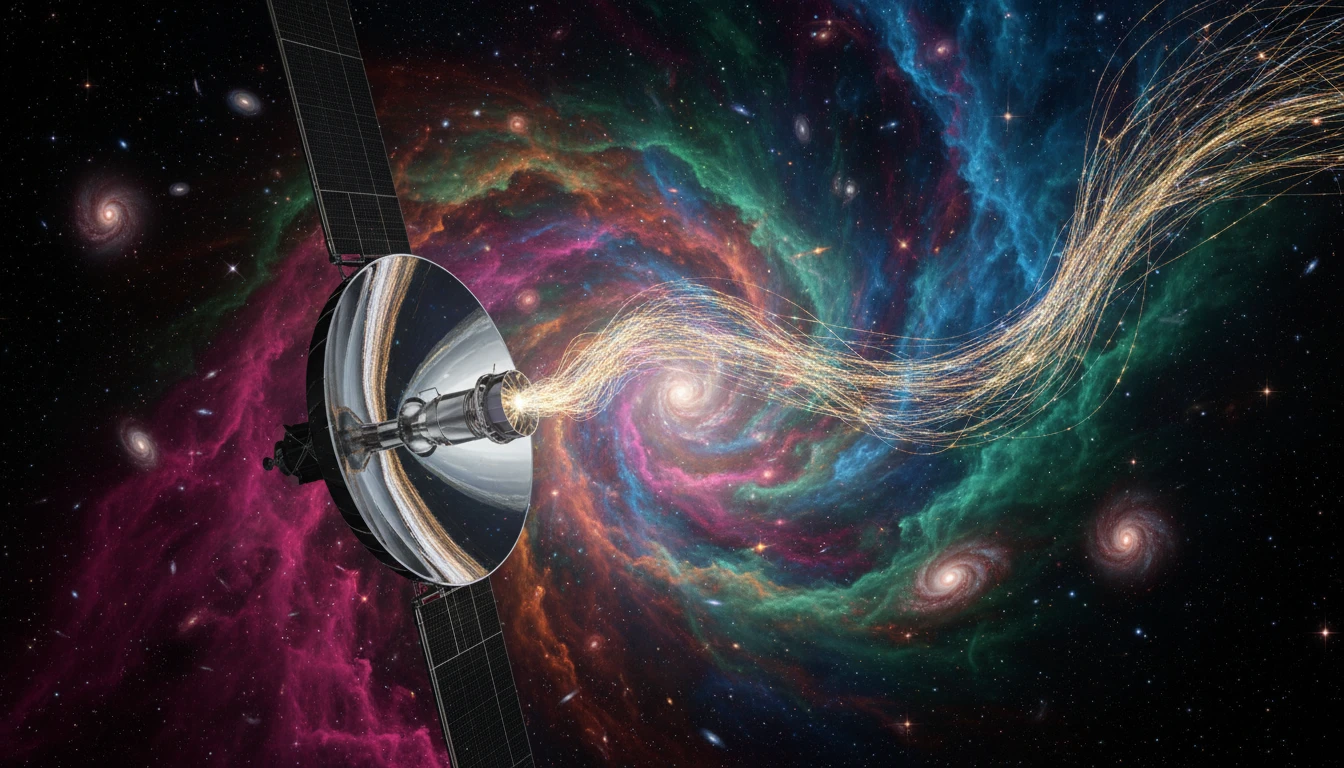
nearly 13 billion years to reach us. Officially named WHL0137-LS, astronomers nicknamed it Earendel, an Old English word for "morning star." Earendel existed when the universe was just 7% of its current age, a mere 900 million years after the Big Bang. It is estimated to be at least 50 times the mass of our Sun and millions of times brighter. Normally, even a star this brilliant would be impossible to spot individually across such an immense distance. So, how did we see it?
A Lens Made of Gravity
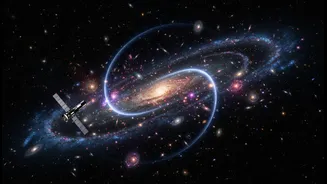
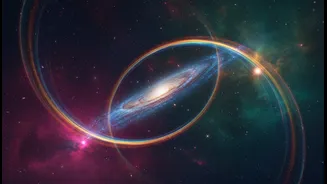
The secret lies in a phenomenon first predicted by Albert Einstein: gravitational lensing. According to his theory of general relativity, massive objects don't just sit in space; they warp the very fabric of spacetime around them. Think of it like placing a heavy bowling ball on a trampoline. The fabric sinks and curves. Now, if you roll a marble past the bowling ball, its path will bend as it follows the curve. Light behaves similarly. When light from a distant object travels past a massive object, like a galaxy or a cluster of galaxies, its path is bent. This massive object acts as a natural, albeit imperfect, magnifying glass. It can distort, brighten, and amplify the light from objects located directly behind it, allowing our telescopes to see things that would otherwise be far too faint and distant.
The Perfect Cosmic Alignment
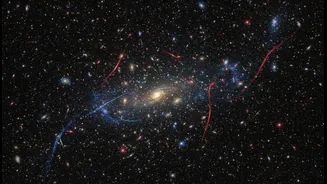
The discovery of Earendel was possible thanks to a rare and fortunate alignment. Situated between Earth and the ancient star is a massive galaxy cluster known as WHL0137-08. The immense gravity of this cluster warped the spacetime around it, creating a powerful natural telescope. The light from Earendel's host galaxy, the Sunrise Arc, was stretched and magnified into the distorted, elongated shapes we call gravitational arcs. What made this observation truly special was Earendel's unique position. The star happened to be located directly along a 'ripple' in spacetime where the magnification effect was at its absolute maximum. This precise geometry amplified the star's light by thousands of times, making it stand out from the smeared light of its home galaxy and allowing Hubble to resolve it as a single point of light.
Why This Discovery Matters
Seeing a single star from the dawn of time is more than just a record-breaking achievement. The universe's first generations of stars were very different from those we see today. They were thought to be composed almost exclusively of hydrogen and helium, the primordial elements created in the Big Bang. Studying a star like Earendel gives scientists a rare opportunity to test these theories and get a direct glimpse into the building blocks of the early cosmos. It provides a unique window into a time when the first galaxies were just beginning to form and evolve. By analysing Earendel's light, which the James Webb Space Telescope has also observed, astronomers can learn about its composition and mass, offering invaluable clues about the life cycle of the very first stars to have lit up the universe.