
A Cosmic Search Problem
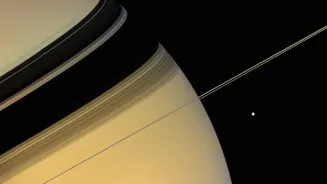
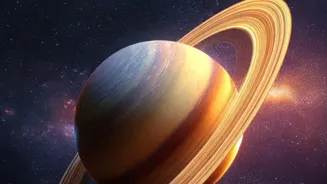
Finding a new moon around Saturn is not as simple as pointing a telescope and looking. The planet itself is immensely bright, and its famous rings create a dazzling glare that easily hides faint objects nearby. Many of the newer moons are incredibly small,
some just a few kilometres in diameter, and they are extremely dim. It's like trying to spot a piece of dark gravel floating next to a giant, brilliant floodlight from over a billion kilometres away. These tiny objects don't produce their own light; we only see them because they reflect a minuscule amount of sunlight. This makes distinguishing a moon from a passing asteroid or just background noise a monumental challenge that requires not just powerful instruments, but also incredibly clever methods.
Pioneering Probes and Powerful Telescopes
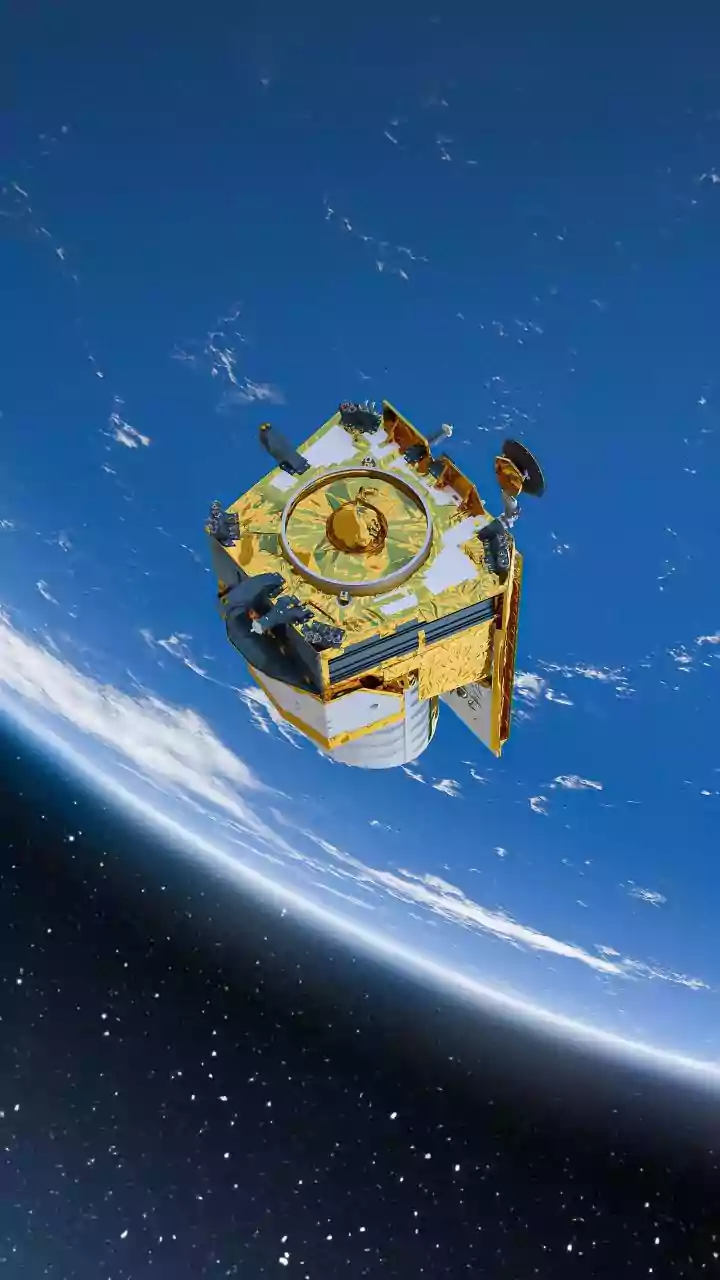
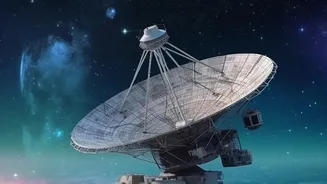
Our modern understanding began with spacecraft that got up close. NASA's Cassini mission, which orbited Saturn from 2004 to 2017, was revolutionary. It discovered several new moons and provided unprecedented data on their composition and behaviour. But Cassini's mission had to end to avoid contaminating potentially habitable moons like Enceladus. Since then, the search has returned to Earth. Astronomers now use powerful ground-based telescopes, such as the Canada-France-Hawaii Telescope on Mauna Kea. These facilities can capture sequential images of the sky around Saturn over several hours. But even with these advanced tools, a tiny moon is often too faint to appear in a single image. This is where a groundbreaking new technique comes into play.
The 'Shift and Stack' Revolution
The key to finding these faint objects is a computational method called 'shift and stack'. Instead of just layering images on top of one another, which would brighten stars but blur out a moving moon, astronomers shift each image frame to follow the predicted path of a potential moon. Imagine taking a series of photos of a runner at night. If you just stack the photos, the runner becomes a blurry streak. But if you align each photo so the runner is in the exact same spot in the frame, they become clear and bright while the background blurs. The 'shift and stack' method does this digitally with telescope data. By layering dozens of images this way, the faint signal of a tiny moon is amplified, allowing it to 'pop out' from the background noise and be seen for the first time. This method has been responsible for a huge surge in discoveries, including a batch of 62 new moons announced by a team led by astronomer Edward Ashton.
Solving the Mystery of Their Origin
Tracking these tiny objects does more than just add to the tally. It helps unravel the violent history of the Saturnian system. Most of these small moons are classified as 'irregular'. Unlike the large, spherical moons that orbit in the same plane as Saturn's equator, irregular moons have large, tilted, and often backward (retrograde) orbits. These odd orbits are strong evidence that they are not native to Saturn. Scientists believe they were once larger moons or captured asteroids that were shattered by ancient collisions. The fragments from these impacts then settled into the strange orbits we see today. By studying the clusters and orbits of these tiny moons, astronomers can piece together the story of these cataclysmic events, treating each small moon like a fossil from the turbulent youth of our solar system.