





The Fiery Challenge of Arrival
Imagine a spacecraft hurtling towards a planet at speeds over 25,000 kilometres per hour. As it hits the atmosphere, the friction with air molecules generates immense heat, creating temperatures hot enough to melt most metals. For decades, space agencies
have relied on rigid, ablative heat shields—think of the ceramic tiles on the Space Shuttle or the single-use shields on capsules like Apollo—which burn away in a controlled manner to dissipate this heat. While effective, these traditional shields have a fundamental limitation: their size is restricted by the diameter of the rocket fairing they are launched in. This size constraint puts a cap on how much mass can be safely landed, creating a major roadblock for ambitious missions, such as sending human habitats or heavy robotic explorers to Mars.
A New Kind of Spacecraft Umbrella
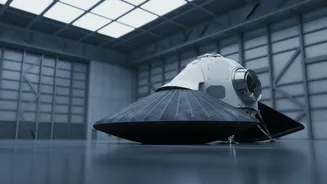
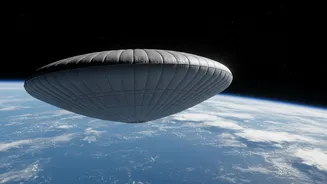
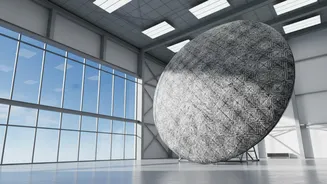
Enter the inflatable heat shield, or as NASA terms it, a Hypersonic Inflatable Aerodynamic Decelerator (HIAD). Instead of a fixed, solid structure, this technology involves a shield that is packed compactly for launch and then inflated like a sophisticated balloon just before atmospheric entry. This allows for a much larger shield than could ever fit inside a conventional rocket nose cone. The structure itself is typically made of stacked, concentric rings woven from synthetic polymers that are, by weight, significantly stronger than steel. This inflatable structure is then covered by a flexible thermal protection system—a multi-layered blanket of advanced, heat-resistant ceramic fabrics and insulation designed to withstand the scorching temperatures of re-entry. Once deployed, it creates a massive, stable, and protective barrier for the spacecraft.
Bigger Shield, Gentler Landing
The core advantage of an inflatable shield is its scale. By creating a much larger surface area, it generates significantly more drag high up in the planet's thin upper atmosphere. This allows the spacecraft to start slowing down sooner and more gradually, reducing the peak temperatures and forces experienced during descent. NASA successfully demonstrated this with its LOFTID (Low-Earth Orbit Flight Test of an Inflatable Decelerator) mission. The six-metre-wide demonstrator survived re-entry speeds of nearly 29,000 kilometres per hour, successfully protecting its core structure before splashing down safely. This approach is not only safer but also more efficient. Lighter than their rigid counterparts and packable into a small volume, inflatable shields free up valuable mass and space for more scientific instruments, cargo, or life-support systems.
Unlocking New Worlds for Exploration
This technology is a game-changer, poised to unlock the next era of planetary exploration. For Mars, which has a very thin atmosphere, a larger decelerator is crucial for landing the heavy payloads required for human missions. Inflatable shields could enable landings at higher-altitude regions on Mars that are currently unreachable. The applications extend across the solar system, with potential missions to Venus and Saturn’s moon Titan also benefiting from this capability. Beyond deep space, the technology holds promise for Earth-based applications. It could enable the cost-effective recovery and reuse of rocket boosters and allow for the safe return of large items manufactured in space. As space agencies like NASA and a consortium of European organisations continue to refine this technology, what was once a concept is now proving to be a viable and powerful tool for exploring new frontiers.