



What is Orbital Edge Computing?
For decades, satellites have operated like cosmic messengers, collecting vast amounts of data—images, signals, and measurements—and beaming it all back to Earth. Here, powerful ground-based computers sift through this digital flood to find useful information.
This process, however, creates a significant bottleneck. Transmitting petabytes of data from orbit is slow and requires enormous bandwidth. Orbital computing, or 'edge computing' in space, flips this model on its head. Instead of sending raw data down, the analysis happens directly on the satellite. It’s the difference between a security camera that sends you hours of empty footage versus one that only alerts you when it spots a person. By embedding AI processors on the satellite itself, it can intelligently filter, analyse, and decide what information is crucial enough to transmit.
India's Foray into Onboard AI
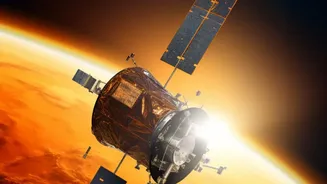
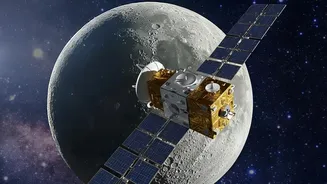
While the Indian Space Research Organisation (ISRO) has been studying the feasibility of in-orbit data centres, the immediate practical application comes from the private sector. Hyderabad-based startup TakeMe2Space is launching its MOI-1A satellite on October 1, 2026, aboard a SpaceX Transporter mission. Described as India's first orbital computing satellite, the sub-50 kg spacecraft is equipped with powerful Nvidia Orin NX chips designed for edge computing. This mission allows customers to upload their own containerized AI models directly to the satellite. As MOI-1A orbits over a specific area of interest, it runs the customer's model, processes the relevant data, and sends back only the finished analysis. This follows a technology demonstration mission in late 2024 that validated the concept of uploading apps and running AI tasks in orbit.
Why 'Thinking' in Orbit Matters
The benefits of this approach are transformative. For disaster management, a satellite can spot the signs of a flood or wildfire and send an immediate alert, rather than waiting for hours of imagery to be downloaded and analysed on the ground. For agriculture, an AI model could monitor crop health across thousands of acres and transmit only a concise report on areas needing water or fertiliser. This dramatically reduces latency and makes satellite data more actionable in real-time. It also democratises access; companies in mining, insurance, and supply chain management can gain valuable insights without building or managing massive data infrastructure on the ground. TakeMe2Space has already signed up 23 customers for its first mission, ranging from mapping firms to educational institutions, highlighting the broad appeal of this service.
Overcoming the Challenges of Space
Putting a computer in space is not as simple as launching a server into orbit. The hardware must be incredibly resilient, capable of withstanding extreme radiation and temperature fluctuations in a vacuum. Power is also a major constraint; the MOI-1A satellite, for example, operates on just 150 watts of power. Furthermore, there are significant engineering hurdles related to security against cosmic threats and potential adversarial interference. The journey for TakeMe2Space has included setbacks, such as the loss of a previous satellite, MOI-1, during a launch vehicle failure in early 2026. Overcoming these obstacles demonstrates a growing maturity in India's private space ecosystem, which is increasingly capable of designing and manufacturing complex satellite systems.
The Bigger Picture for India
This move into orbital computing is more than just a single startup's mission; it aligns with a broader national strategy. ISRO has identified onboard AI as a key technology for future satellite systems, envisioning a new generation of spacecraft that can make decisions autonomously. This capability is crucial for everything from national security, where faster intelligence gathering provides a strategic edge, to scientific missions. As India pursues ambitious projects like the Gaganyaan human spaceflight mission and further exploration of the Moon and beyond, the ability to process information intelligently in space will be indispensable. This experiment represents a foundational step, moving India from being a user of space data to a pioneer in creating intelligent space infrastructure.