




The Challenge of Launch Weight
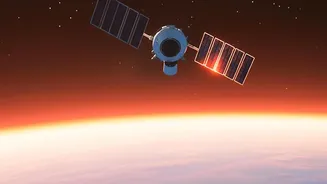
In space travel, mass is everything. The heavier a satellite, the more powerful and expensive the rocket required to hoist it into orbit. A significant portion of a satellite's launch mass is dedicated to conventional chemical propellants. This fuel is necessary
for crucial manoeuvres, such as raising the satellite to its final orbit after launch and making small adjustments throughout its life to maintain its correct position, a process known as station-keeping. For large communication satellites, fuel can account for more than half of their total weight. This creates a fundamental trade-off: every kilogram of fuel is a kilogram that cannot be used for the actual payload, like the transponders and sensors that perform the satellite's mission.
Electric Propulsion: A More Efficient Solution
Electric propulsion (EP) systems offer a revolutionary alternative. Instead of the powerful, short-lived bursts of chemical rockets, EP systems provide a very gentle but continuous thrust over a long period. Think of it as the difference between a powerful cannon blast and a steady, persistent breeze. While the immediate force is much lower, the sustained push is incredibly efficient. These systems use electrical power, typically generated by the satellite's solar panels, to accelerate a propellant like xenon gas to extremely high speeds. The key advantage lies in their high 'specific impulse'—a measure of how efficiently a rocket uses propellant. Electric thrusters can be five to ten times more efficient than their chemical counterparts, meaning they can achieve the same change in velocity with a fraction of the fuel.
How ISRO's System Works
ISRO's indigenous systems, like the Hall-effect thrusters developed by its Liquid Propulsion Systems Centre (LPSC), are at the forefront of this technology. In a Hall thruster, xenon gas is fed into a chamber. There, an electric field strips electrons from the xenon atoms, turning them into positively charged ions (a plasma). A magnetic field then traps the electrons while the powerful electric field accelerates the heavy xenon ions out of the thruster at very high velocity. This stream of ejected ions produces the thrust. While early missions like GSAT-9 in 2017 used imported thrusters, ISRO is now developing its own fully indigenous systems, such as the 300 mN thruster slated for demonstration on the TDS-01 satellite.
Benefit 1: Slashing Launch Mass
The most significant advantage of this high efficiency is a dramatic reduction in launch mass. By replacing hundreds of kilograms of heavy chemical fuel with a much smaller amount of xenon gas, the overall weight of the satellite plummets. For example, a 5,000 kg communication satellite that would typically carry around 2,500 kg of chemical fuel could be redesigned to use an electric propulsion system and require only a few hundred kilograms of xenon. This massive weight saving means the satellite can be launched on a smaller, less expensive rocket, or the saved mass can be reallocated to the payload. This allows ISRO to pack more transponders, advanced sensors, or other revenue-generating equipment onto each satellite, significantly increasing its capability and return on investment.
Benefit 2: Extending a Satellite's Lifespan
The second key benefit is a longer operational life. A satellite's mission often ends not because its electronics fail, but because it runs out of the fuel needed for station-keeping. Due to solar radiation pressure and gravitational pulls from the Sun and Moon, a satellite in geostationary orbit naturally drifts. Chemical thrusters perform periodic burns to correct this drift, but their fuel supply is finite. Because electric propulsion is so fuel-efficient, the same amount of propellant can last much longer. This allows a satellite to perform station-keeping manoeuvres for many more years, extending its useful service life from a typical 15 years to potentially 20 or more. This enhanced orbital endurance makes India's satellite fleet more resilient and economically valuable over the long term.