



The Universe's Grand Design
For decades, scientists have theorized that galaxies are not scattered randomly throughout space. Instead, they are organized into a colossal, web-like structure. This network, known as the cosmic web, is the largest known structure in the universe. It
consists of immense, thread-like filaments of dark matter and gas, connecting dense clusters of galaxies. These filaments are stretched across vast, nearly empty regions called voids. Think of it as a cosmic skeleton, with galaxies forming at the joints and along the bones. This underlying framework is believed to have dictated where galaxies formed and how they have evolved over the past 13.8 billion years. The challenge, however, has always been that this architecture is mostly invisible. The dominant component, dark matter, does not emit, reflect, or block light, making it impossible to see directly.
Seeing the Invisible with New Eyes
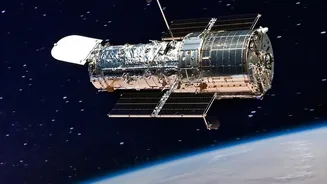
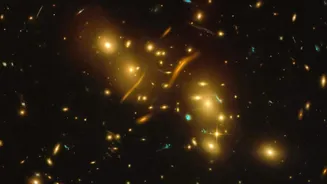
So how do you map something you can't see? The latest breakthroughs come from NASA's James Webb Space Telescope (JWST). With its unparalleled sensitivity and powerful infrared instruments, JWST can detect the faint light from the most distant galaxies—galaxies that were invisible to previous observatories like the Hubble Space Telescope. A recent major survey called COSMOS-Web has used JWST to create the most detailed map of the cosmic web to date. By observing a patch of sky about the size of three full moons, astronomers were able to detect and precisely measure the distances to over 164,000 galaxies, tracing the cosmic web back to when the universe was just a billion years old. The new map is significantly sharper than previous ones, revealing structures that were once blurred or completely hidden. This allows scientists to see the invisible scaffolding of the universe in stunning new detail.
Filaments of Dark Matter and Gas
The new maps confirm that ordinary matter, the stuff that makes up stars and planets, faithfully traces the underlying structure shaped by dark matter. The JWST data reveals dense regions of dark matter linked by lower-density filaments, making the web-like pattern clearer than ever before. These filaments act as cosmic highways, channeling gas and matter toward the intersections where galaxies are born and grow. In some cases, astronomers have even been able to directly observe the faint glow of hydrogen gas in these filaments, illuminated by the intense radiation from a nearby quasar, like a flashlight revealing a spider's web in the dark. Other studies have used different techniques, like analyzing faint 'Lyman-alpha' light from energized hydrogen, to create 3D maps of these structures from 9 to 11 billion years ago, revealing hidden galaxies and gas clouds.
Why This Cosmic Map Matters
Mapping the cosmic web does more than just create a pretty picture. It provides a crucial test for our understanding of the entire universe. By comparing these detailed observations to computer simulations of how the universe should have evolved, scientists can refine their models of cosmology. These findings provide strong evidence that gravity, acting on tiny density variations in the early universe, was the primary force that sculpted the web-like structure we see today. Understanding this architecture helps us answer fundamental questions: How did galaxies get their gas to form stars? How are massive galaxy clusters assembled? And what does this large-scale structure tell us about the mysterious nature of dark matter itself? Recent discoveries have even suggested that some of these enormous filaments, stretching for millions of light-years, might be slowly rotating, which could imply that the spin of individual galaxies is inherited from the cosmic web itself.