
For decades, we've understood the universe to be about 13.8 billion years old. But recent observations have led to a provocative new theory suggesting our cosmos might be nearly twice that age, potentially rewriting the story of everything.
The Standard Story of Our Universe
The prevailing
scientific consensus is that the universe began 13.797 billion years ago with the Big Bang. This understanding is encapsulated in the Lambda-Cold Dark Matter (ΛCDM) model, which has been incredibly successful at explaining a vast range of cosmic phenomena, from the faint afterglow of the Big Bang, known as the cosmic microwave background, to the large-scale structure of galaxies we see today. The model posits a universe composed of ordinary matter, but also two mysterious components: 'dark energy', an unseen force causing the universe's expansion to accelerate, and 'dark matter', an invisible substance providing the extra gravitational pull needed to hold galaxies together. Together, these two are thought to make up about 95% of the cosmos.
A Wrinkle in Cosmic Time
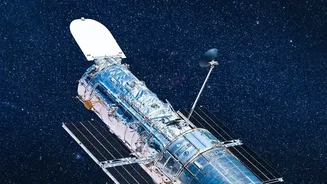
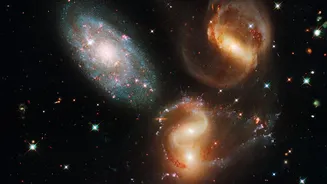
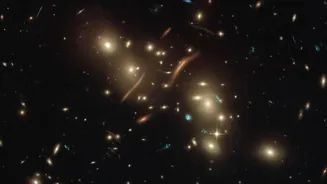
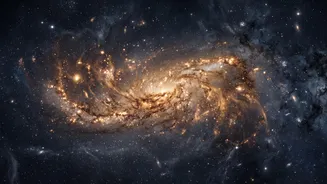
The highly successful ΛCDM model has recently faced a significant puzzle. Data from the James Webb Space Telescope (JWST) has revealed galaxies in the very distant, and therefore very early, universe that are surprisingly massive and mature. Under the standard 13.8-billion-year timeline, some of these galaxies appear to have formed and developed with astonishing speed, seemingly too advanced for their age. This 'impossible early galaxy problem' has prompted some astronomers to question whether the standard model is the full story, opening the door for alternative explanations.
An Alternative Proposal: A Much Older Universe
One of the most radical new ideas comes from Rajendra Gupta, a professor at the University of Ottawa. He has developed a model that estimates the age of the universe to be 26.7 billion years old. This alternative framework is called the CCC+TL model, which stands for 'Covarying Coupling Constants plus Tired Light'. In a series of papers, Gupta and his colleagues argue that their model can not only account for the mature galaxies seen by the JWST but may also explain cosmic observations without the need for dark matter or dark energy.
How the New Model Works
The CCC+TL model combines two older, unconventional ideas. The first is the 'tired light' hypothesis, first proposed by Fritz Zwicky in 1929. It suggests that photons (particles of light) gradually lose energy as they travel across billions of light-years. This energy loss would cause their light to shift towards the red end of the spectrum, an effect that cosmologists currently attribute entirely to the expansion of space. The second component involves 'covarying coupling constants', suggesting that the fundamental forces of nature, which are assumed to be constant, might actually change over cosmic time. By blending these two concepts, the model reinterprets the redshift of distant galaxies, suggesting they are much farther away—and thus their light has been traveling for much longer—than previously thought.
Solving the 'Impossible Galaxy' Puzzle
A universe that is 26.7 billion years old provides a simple solution to the puzzle of the unexpectedly mature early galaxies. In the standard model, the era when the first stars and galaxies formed, known as the 'cosmic dawn', occurred when the universe was only about 300 million years old. In the CCC+TL model, however, the universe would have already been about 4.6 billion years old at the same observed point in time. This vast expanse of extra time would allow for the slow and steady formation of the large, well-developed galaxies that the JWST has spotted, making these 'impossible' galaxies entirely predictable.
A Challenger in the Scientific Arena
It is crucial to understand that the CCC+TL model is a provocative proposal, not a proven theory that has replaced the standard ΛCDM model. While Gupta and his colleagues have shown it can successfully match several key observations—such as the amount of light elements created after the Big Bang and the rotation of galaxies without needing dark matter—the idea remains outside the scientific mainstream. The 'tired light' hypothesis, in particular, has historically been dismissed because previous versions predicted effects, like the blurring of distant objects, that are not observed. The scientific community will require much more evidence and independent testing before a radical revision of the universe's age is widely considered.