




The Current Orbit and The Next Frontier
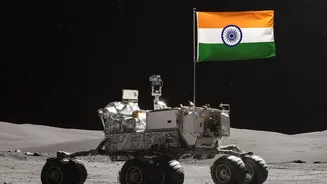
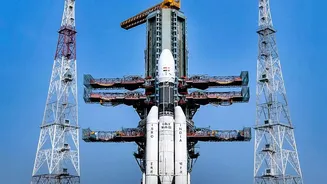
India, through the Indian Space Research Organisation (ISRO), has established itself as a formidable power in space. With a robust constellation of satellites for communication, Earth observation, and navigation, the country has leveraged space technology
for everything from disaster management to national security. However, the global space landscape is shifting. The new race is not just about getting to space, but about creating intelligent, autonomous, and incredibly secure infrastructure in orbit. This is where AI and quantum mechanics enter the picture, promising to upgrade India’s eyes and ears in the sky into brains in the sky.
AI: Giving Satellites an Onboard Brain
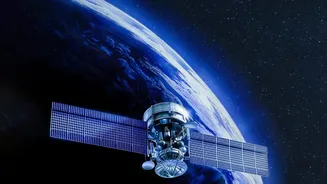
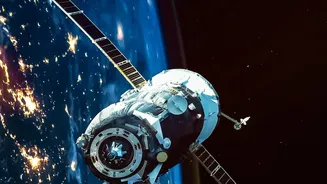
Traditionally, satellites are giant data collectors that beam raw information back to Earth for processing. This creates a significant time lag and a bottleneck in data transmission. Artificial intelligence and machine learning (AI/ML) are set to change this paradigm completely. ISRO is actively exploring and implementing AI for on-board processing and edge computing. This will allow satellites to analyse data in real-time, right from orbit. Imagine a satellite monitoring for floods being able to instantly identify affected areas and send processed, actionable alerts directly to ground teams, instead of transmitting terabytes of raw imagery. This capability, sometimes called an 'orbital data centre,' is being explored by both ISRO and private Indian space-tech startups like Pixxel and Sarvam AI. AI will also be crucial for predictive maintenance, allowing satellites to self-diagnose issues, and for autonomous navigation, making constellations more resilient and efficient.
Quantum: The Unhackable Shield
As our reliance on satellites grows for critical functions like financial transactions, military communications, and strategic navigation, so does the risk of cyber threats like spoofing and hacking. This is where quantum technology offers a game-changing solution. ISRO is making significant strides in Quantum Key Distribution (QKD), a method that uses the principles of quantum physics to create theoretically unhackable communication channels. Any attempt to eavesdrop on a quantum communication link disturbs it, immediately alerting the parties. ISRO has already successfully demonstrated free-space QKD over hundreds of meters and is gearing up for satellite-based demonstrations. This technology will be foundational for securing India's military, financial, and governmental communications, making them 'future-proof' against even the most powerful computers of tomorrow.
The Roadmap: What to Watch For
India's push into these advanced technologies is not just theoretical. The government's National Quantum Mission, launched in 2023, is aggressively funding this research, with goals to establish satellite-based secure communication over 2,000 km. ISRO, in collaboration with institutions like the Raman Research Institute, is working towards launching a dedicated quantum communication satellite. We can expect to see more advanced AI algorithms integrated into upcoming Earth observation and surveillance satellites to enhance data analysis for governance, urban planning, and security. The growth of India's private space sector, with nearly 400 startups by 2026, will also accelerate innovation, as companies develop specialised AI-driven applications and services based on satellite data. The convergence of these technologies will not happen overnight, as challenges in miniaturisation, radiation hardening of components, and talent development remain, but the direction is clear and the commitment is strong.