




Welcome to the 'Ultra-Hot Jupiters'
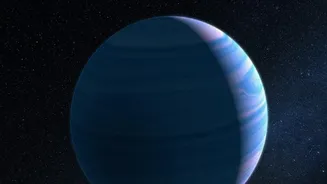
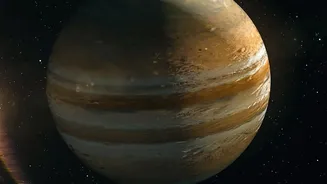
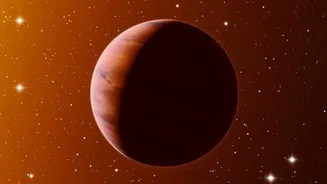
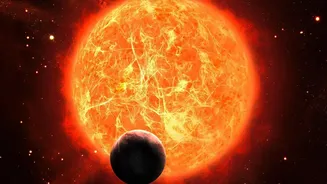
The planets hosting these extreme weather systems belong to a category known as 'ultra-hot Jupiters.' A prime example is WASP-76b, a gas giant located about 640 light-years from Earth. These worlds are tidally locked to their parent stars, meaning one
side perpetually faces the star while the other is in constant darkness. This creates an incredible temperature difference. The dayside of WASP-76b, for instance, sizzles at over 2,400 degrees Celsius, hot enough to vaporize metals like iron. In contrast, the nightside is a 'cooler' 1,500 degrees Celsius. This massive temperature gradient between the day and night sides is the engine that drives the planet's ferocious weather.
How Telescopes See Alien Weather
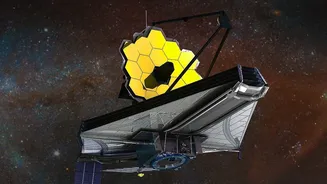
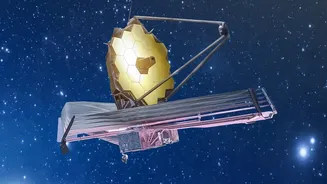
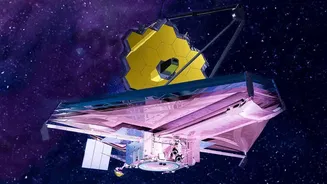
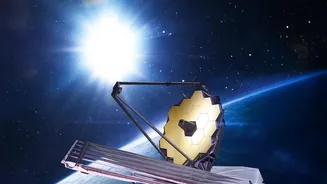
Astronomers can't see this weather directly, but they can deduce its presence using powerful infrared telescopes and a technique called spectroscopy. When an exoplanet passes in front of its star from our point of view, starlight filters through the planet's atmosphere. Different chemical elements in the atmosphere absorb specific wavelengths, or colours, of light. By analyzing the starlight before and during this transit, scientists can identify the chemical 'fingerprints' left behind. Instruments like the ESPRESSO spectrograph on the European Southern Observatory's Very Large Telescope and NASA's James Webb Space Telescope excel at this, allowing researchers to map the chemical composition and dynamics of these distant atmospheres.
A Forecast of Iron Rain
On the blistering dayside of a planet like WASP-76b, the intense heat turns iron into a gas. Powerful winds, estimated to blow at speeds of up to 18,000 km/h, then carry this iron vapour across the planet to the perpetually dark nightside. As the iron vapour reaches the cooler nightside, it condenses back into liquid, forming clouds of molten iron. From these clouds, it then rains droplets of liquid iron down into the planet's deep atmosphere. Astronomers detected this phenomenon by observing a strong signature of iron vapour on the planet's 'evening' edge, where day turns to night, but saw it disappear on the 'morning' edge, confirming that the iron had rained out during the night.
Winds Faster Than Sound
The iron rain is just one part of the extreme climate. The massive temperature difference also generates powerful jet streams. On another ultra-hot Jupiter, WASP-121b, astronomers have clocked winds moving at supersonic speeds. These are not just horizontal winds; researchers have mapped the atmosphere in three dimensions, revealing complex weather patterns where energy is transported deep into the planet. These winds blow clouds of vaporized iron and titanium at speeds faster than the planet itself rotates. One researcher described the atmosphere's behaviour as something that challenges our entire understanding of how weather works, calling it something out of science fiction.
Why These Hellish Worlds Matter
Studying these seemingly inhospitable worlds is more than just a scientific curiosity. They act as natural laboratories for testing and refining our models of planetary atmospheres under extreme conditions. Understanding the physics and chemistry at play on hot Jupiters helps scientists better comprehend planet formation and evolution across the galaxy. The same techniques used to detect iron rain are being refined to search for molecules like water, methane, and carbon dioxide in the atmospheres of smaller, rocky planets. Each discovery, no matter how bizarre, sharpens the tools and knowledge needed in the ongoing search for worlds that might one day be identified as habitable.