




A Sweet Discovery in Deep Space
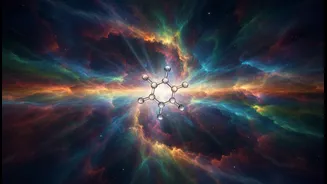
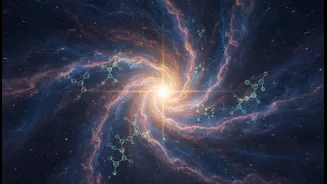
Using powerful radio telescopes in Spain, an international team of scientists detected the chemical fingerprint of erythrulose in a vast cloud of gas and dust called G+0.693-0.027, located about 26,745 light-years from Earth. Erythrulose is a four-carbon
sugar, and while it's found in small amounts in raspberries on Earth, finding it in the interstellar medium is a first. This makes it the largest non-cyclic molecule and the very first true sugar identified in the space between stars. Previously, scientists had found sugars on meteorites and asteroids, suggesting they might come from space, but a direct detection in an interstellar cloud remained elusive until now. The discovery was made by matching 12 specific radio emission lines from the cloud to the unique spectral signature of erythrulose measured in a lab.
A Vital Ingredient for Life's Recipe
Sugars are essential for life as we know it, serving as energy sources and, crucially, as structural components of RNA and DNA. The discovery of erythrulose is particularly exciting because it's considered a prebiotic molecule—a chemical stepping stone to life. In water, erythrulose can transform into other sugars like threose, which is thought to be a possible evolutionary ancestor to RNA. This discovery lends significant weight to the "RNA World" hypothesis, which suggests that RNA, not DNA, was the primary form of genetic storage for early life. Finding a key precursor to RNA's building blocks forming naturally in space suggests the universe is capable of making life's ingredients far from any planet.
Challenging Our Understanding of Cosmic Chemistry
One of the most surprising aspects of the discovery is the abundance of erythrulose. The team found it to be at least eight times more common than any simpler, three-carbon sugars, which weren't detected at all. This challenges the long-held belief that complex molecules in space form incrementally, by adding one carbon atom at a time. Instead, it seems erythrulose likely forms on the icy surfaces of dust grains from the combination of simpler, two-carbon molecules that are abundant in space, such as glycolaldehyde and ethylene glycol. These interstellar dust grains act like tiny cosmic factories, assembling more complex structures that can eventually seed new star systems.
The Real Decisions for Astronomers
This finding is more than just an exciting addition to the growing list of over 300 molecules found in space. It provides actionable intelligence that directly influences future astronomical research. Knowing that molecules as complex as four-carbon sugars can form in these environments helps astronomers make critical decisions about where to point their most powerful instruments, like the James Webb Space Telescope (JWST). Regions rich in erythrulose and its precursors become high-priority targets for studying the full inventory of prebiotic chemicals. This helps refine the search for potentially habitable worlds and biosignatures by focusing on star systems that may have inherited these life-giving ingredients. It allows scientists to better allocate precious and highly competitive telescope time, focusing on the cosmic nurseries most likely to contain the complete recipe for life.
From Stardust to Life on Earth
The discovery reinforces a profound idea: the ingredients for life on Earth may have arrived from outer space. Scientists estimate that millions of tonnes of erythrulose could have been delivered to our young planet during the Late Heavy Bombardment, a period of intense comet and asteroid impacts about 4 billion years ago. This cosmic delivery could have enriched the "prebiotic soup" on Earth, providing a crucial stock of complex sugars that laboratory experiments suggest are difficult to form on a planet's surface alone. In essence, the discovery of erythrulose in a distant gas cloud forges a tangible link between the chemistry happening across our galaxy and the origins of life on our own world, suggesting the path to life may be a universal process.