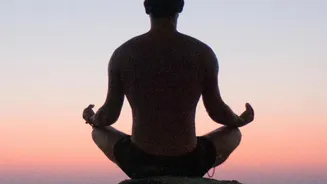








From sacred texts in ancient India to glossy studios in every major city, yoga has travelled far. This ancient practice for mindful wellness has transformed into a global lifestyle industry. How did a path to spiritual enlightenment become so popular?
Ancient Roots and Spiritual Goals
Yoga's story begins over 5,000 years ago in ancient India, with its earliest mentions found in sacred texts like the Rig Veda. It wasn't about fitness or flexibility; it was a comprehensive spiritual discipline aimed at uniting the mind, body, and spirit to achieve enlightenment. Rooted in the philosophical traditions of Hinduism and Buddhism, early forms of yoga were passed down from teacher to student, focusing on meditation, breathing techniques (pranayama), and ethical principles. The physical postures, or asanas, were just one part of a much larger system designed to prepare the body for long periods of meditation. The goal was self-realization, a profound connection between the individual and the universe.
A Bridge to the Western World
For centuries, yoga remained largely within the Indian subcontinent. Its global journey began in earnest in the late 19th century. The pivotal moment came in 1893 when Swami Vivekananda addressed the Parliament of Religions in Chicago. He introduced Vedanta philosophy and the concepts of yoga to a captivated American audience. Vivekananda focused on the philosophical and meditative aspects—Raja, Jnana, Karma, and Bhakti yoga—rather than the physical postures, which were then associated with street performers in India. He presented yoga as a universal path to spiritual experience, transcending religious and cultural boundaries, which made it immensely appealing to open-minded Westerners.
The Pioneers of Modern Postural Yoga
The 20th century saw a major shift towards the physical practice of yoga, thanks to a few key figures. T. Krishnamacharya, often called 'the father of modern yoga', and his students were instrumental in this evolution. One of his most influential students, B.K.S. Iyengar, played a massive role in popularizing asana practice globally. Iyengar developed a method that emphasized precise physical alignment and the use of props like blocks and straps. This innovation made yoga accessible to people of all ages and abilities, transforming it from an esoteric practice into something anyone could try. His book 'Light on Yoga' became an international bestseller, serving as a guide for a new generation of yoga practitioners in the West.
From Counter-Culture to Mainstream Fitness
By the 1960s and 70s, yoga found a new home within the Western counter-culture movement, embraced for its association with peace, spirituality, and a rejection of materialism. But the next big transformation occurred in the 1980s and 90s. As the fitness boom took hold, yoga began to be framed primarily as a form of exercise. Studios sprang up, marketing yoga as a way to build strength, increase flexibility, and, crucially, reduce stress in a fast-paced modern world. This shift stripped away much of the overt spiritual context, making it more palatable and accessible to a broader, secular audience. It was no longer just for hippies or spiritual seekers; it was for anyone looking for a good workout and a moment of calm.
The Global Lifestyle and Billion-Dollar Industry
Today, yoga is a full-fledged global lifestyle phenomenon. The industry, encompassing classes, teacher trainings, apparel, retreats, and accessories, is valued at over a hundred billion dollars worldwide. There are more than 300 million practitioners globally. The rise of 'athleisure' fashion, with yoga pants becoming everyday wear, highlights how deeply the practice has integrated into modern culture. This commercialization, however, has sparked debate. Critics raise concerns about cultural appropriation and the dilution of yoga's spiritual essence when it is packaged and sold as a consumer product. The focus on physical fitness often overshadows the practice's deep philosophical roots.